2023 · Jebabli et al. — Acute Effect of Hydrogen-Rich Water on Physical, Perceptual and Cardiac Responses During Aerobic and Anaerobic Exercises: A Randomized, Placebo-Controlled, Double-Blinded Cross-Over Trial
Super-Abstract
In 22 male amateur middle-distance runners, 500 mL of hydrogen-rich water 30 minutes before testing was reported to improve time to exhaustion, peak heart rate and perceived exertion compared with placebo, while the jump tests showed no significant change. For maximal aerobic speed the abstract contradicts itself: the results report an improvement, the conclusion reports no significant effect. The abstract gives no numbers or p-values and does not say whether peak heart rate rose or fell. (Frontiers in Physiology, 2023.)
Commentary
Hydrogen-rich water is regarded as an ergogenic aid, but the effect of a single drink shortly before exercise is unclear. Twenty-two male amateur middle-distance runners took part in a randomised, double-blind trial with a crossover design according to the title. They drank 500 mL of hydrogen-rich water or placebo 30 minutes before the tests. Over 4 days the researchers measured maximal aerobic speed in the Vameval test (MAS), time to exhaustion at MAS (Tlim), squat jump, countermovement jump and a five-jump test. Rate of perceived exertion (RPE) and peak heart rate were recorded during the aerobic tests. The abstract does not give the hydrogen concentration, the placebo composition, the order of tests, a primary endpoint, any numerical results or adverse events.
Key quotes
- „For Vameval test, HRW ingestion improved MAS, HRpeak and RPE compared with the placebo condition.“ — results for the incremental running test, including maximal aerobic speed
- „However, no significant change was observed between HW and placebo conditions in SJ, CMJ, 5JT.“ — the null result for all three jump tests
- „500 mL of HRW can significantly improve HRpeak, time to exhaustion, RPE, with no significant effect on MAS, jumping performance in amateur endurance athletes.“ — the conclusion, which lists maximal aerobic speed as not significant
Our assessment
A randomised, double-blind crossover design suits the question of a single drink before exercise. What the study found is hard to judge from the abstract alone. It reports no effect sizes, p-values or confidence intervals, it does not say whether peak heart rate went up or down, and it contradicts itself on maximal aerobic speed. The jump tests showed no significant change. Limitations: one 500 mL dose with unknown hydrogen concentration, male amateur runners only, several performance and perceptual outcomes without a named primary endpoint, no numerical results in the abstract, and a contradiction between results and conclusion. Perceived exertion is subjective, and the abstract does not describe how the placebo was matched. Adverse events are not reported.
Study design
- Type: randomised, double-blind crossover trial (crossover per title) · n: 22 male amateur middle-distance runners · H₂ delivery: 500 mL hydrogen-rich water 30 minutes before testing, concentration not stated
- Comparator: placebo drink (composition not described in the abstract)
- Result: no primary endpoint named and no numbers given. Vameval test: improvements reported in MAS, peak heart rate and RPE. Tlim test: improvements reported in time to exhaustion, RPE and peak heart rate. No significant change in squat jump, countermovement jump or five-jump test. The conclusion states no significant effect on MAS, contrary to the results
Abstract
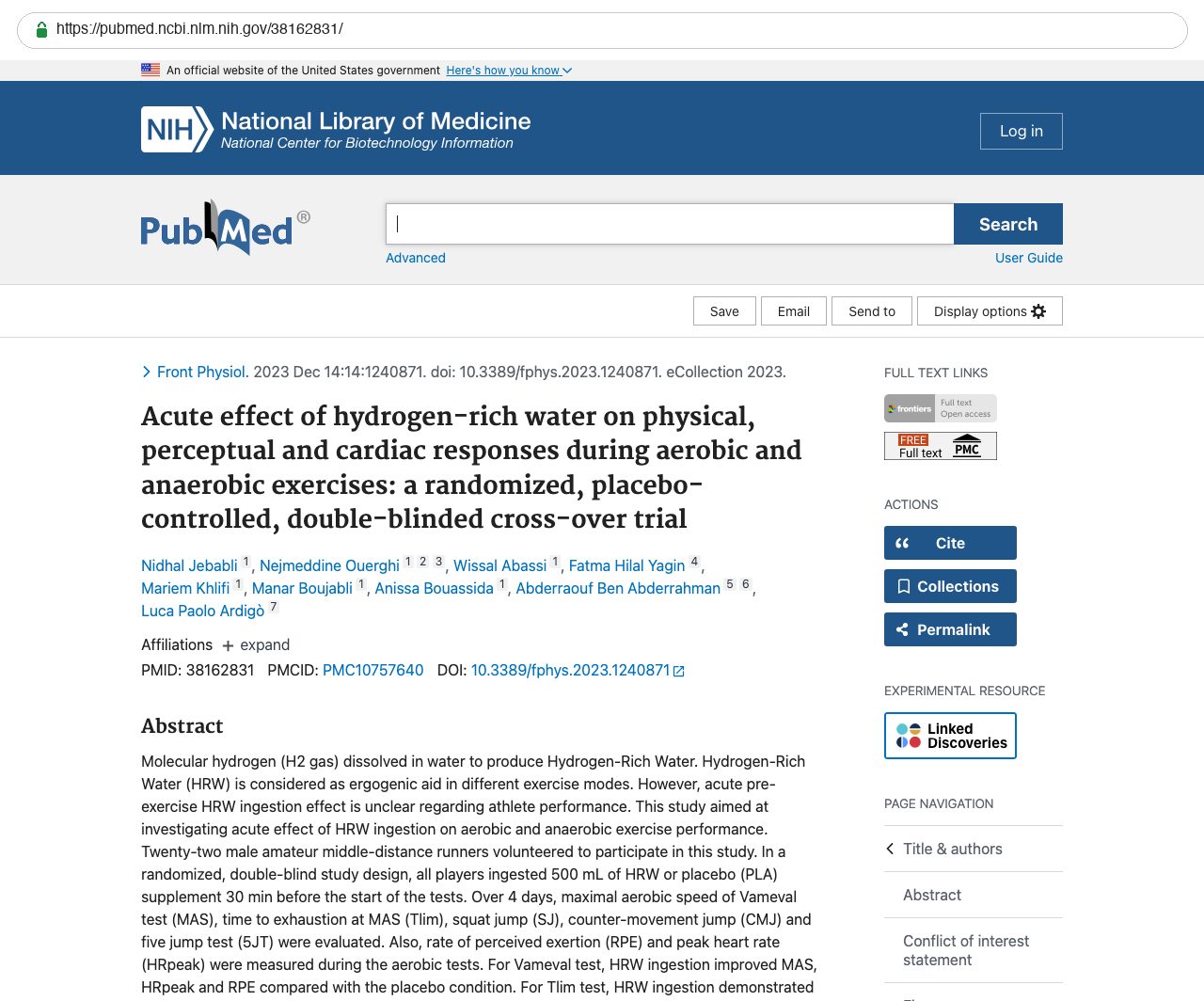
Molecular hydrogen (H2 gas) dissolved in water to produce Hydrogen-Rich Water. Hydrogen-Rich Water (HRW) is considered as ergogenic aid in different exercise modes. However, acute pre-exercise HRW ingestion effect is unclear regarding athlete performance. This study aimed at investigating acute effect of HRW ingestion on aerobic and anaerobic exercise performance. Twenty-two male amateur middle-distance runners volunteered to participate in this study. In a randomized, double-blind study design, all players ingested 500 mL of HRW or placebo (PLA) supplement 30 min before the start of the tests. Over 4 days, maximal aerobic speed of Vameval test (MAS), time to exhaustion at MAS (Tlim), squat jump (SJ), counter-movement jump (CMJ) and five jump test (5JT) were evaluated. Also, rate of perceived exertion (RPE) and peak heart rate (HRpeak) were measured during the aerobic tests. For Vameval test, HRW ingestion improved MAS, HRpeak and RPE compared with the placebo condition. For Tlim test, HRW ingestion demonstrated improvements in time to exhaustion, RPE and HRpeak. However, no significant change was observed between HW and placebo conditions in SJ, CMJ, 5JT. 500 mL of HRW can significantly improve HRpeak, time to exhaustion, RPE, with no significant effect on MAS, jumping performance in amateur endurance athletes.
Source & links
Screenshot of the PubMed page
This page mirrors the published abstract (© the authors / publisher) for reference and citation. The canonical source is the PubMed record linked above. This is not medical advice.