2026 World journal of orthopedics Review / Meta-analysis Unspecified Joints / RheumatologySports & Exercise
2026 · Jeyaraman et al. — Molecular Hydrogen Therapy in Musculoskeletal Conditions: An Evidence-Based Review and Critical Analysis
Super-Abstract
This narrative review of 45 studies on hydrogen in musculoskeletal conditions reports that clinical trials found symptom relief in osteoarthritis, lower disease activity in rheumatoid arthritis and faster clearance of muscle damage markers, but it gives no pooled effect sizes. Of the 45 studies, 25 were preclinical and 20 were clinical trials. The authors name small samples, short durations and differing protocols as common weaknesses, and the varied delivery methods prevented direct comparison. (World Journal of Orthopedics, 2026.)
Commentary
Hydrogen is described as having antioxidant and anti-inflammatory properties, and this review examined the preclinical and clinical evidence for its use in musculoskeletal conditions ranging from osteoarthritis and rheumatoid arthritis to exercise-induced muscle damage, chronic pain, tendinopathies and muscle wasting (atrophy). It is a narrative review. Per full text, the authors ran a systematic search, had two reviewers screen studies and assessed risk of bias, but they summarised the results condition by condition without a meta-analysis. The abstract names three databases (PubMed, EMBASE, Cochrane Library) searched up to April 2025; per full text, Scopus and Web of Science were also searched and only English-language articles were included. The search yielded 45 eligible studies. The H₂ forms were hydrogen-rich water, gas inhalation and saline infusion. The abstract gives no total number of participants, no doses or durations and no risk-of-bias results. It also does not say how many of the clinical trials were randomised or placebo-controlled.
Key quotes
- „Clinical trials reported symptomatic relief in osteoarthritis, decreased Disease Activity Score 28 in rheumatoid arthritis, and accelerated clearance of muscle damage markers.“ — the review's summary of the clinical findings, given without effect sizes
- „Common limitations included small sample sizes, short durations, and protocol heterogeneity.“ — the authors' own list of weaknesses in the included trials
- „Despite these constraints, findings suggest H2 may serve as a promising adjunctive therapy via antioxidant, anti-inflammatory, and cytoprotective mechanisms.“ — the authors' conclusion, framed as a suggestion for add-on use
Our assessment
The review maps the evidence across six groups of conditions and lists the main weaknesses of the trials. It provides no pooled estimates, so it cannot say how large or how certain any effect of hydrogen is. The clinical findings in the abstract are stated without numbers, sample sizes or p-values, and results in cells and animals do not show effects in people. Limitations: narrative synthesis of heterogeneous studies, restricted to English-language articles per full text. The abstract notes differing delivery methods, inconsistently reported mechanistic biomarkers, small samples, short durations and differing protocols. It does not report the risk-of-bias results and does not mention trials without an effect. The abstract and the full text name different sets of databases. The authors call hydrogen a possible add-on therapy. On the evidence summarised here, that remains a hypothesis for the longer randomised trials the authors themselves call for.
Study design
- Type: narrative review with a systematic literature search and risk-of-bias assessment (per full text), no meta-analysis · n: 45 studies (25 preclinical, 20 clinical trials), total participants not given · H₂ delivery: hydrogen-rich water, gas inhalation or saline infusion, depending on the study
- Included studies: preclinical studies and clinical trials on musculoskeletal conditions, from osteoarthritis and rheumatoid arthritis to muscle damage, chronic pain and tendinopathy, plus muscle atrophy; search up to April 2025
- Result: no pooled effect sizes. Preclinical: lower reactive oxygen species and inflammatory cytokines, better cell viability. Clinical: symptom relief in osteoarthritis, lower Disease Activity Score 28 in rheumatoid arthritis, faster clearance of muscle damage markers (no figures in the abstract)
Abstract
Molecular hydrogen (H2) demonstrates selective antioxidant and anti-inflammatory properties with therapeutic potential across musculoskeletal conditions including osteoarthritis, rheumatoid arthritis, exercise-induced muscle damage, chronic pain syndromes, tendinopathies, and muscle atrophy. This review critically evaluates preclinical and clinical evidence for H2 therapy and identifies research gaps. A comprehensive search of PubMed, EMBASE, and Cochrane Library (up to April 2025) yielded 45 eligible studies: 25 preclinical and 20 clinical trials. Preclinical models consistently showed reductions in reactive oxygen species, inflammatory cytokines, and improved cell viability. Clinical trials reported symptomatic relief in osteoarthritis, decreased Disease Activity Score 28 in rheumatoid arthritis, and accelerated clearance of muscle damage markers. Delivery methods varied - hydrogen-rich water, gas inhalation, and saline infusion - hindering direct comparison. Mechanistic biomarkers were inconsistently reported, limiting understanding of target engagement. Common limitations included small sample sizes, short durations, and protocol heterogeneity. Despite these constraints, findings suggest H2 may serve as a promising adjunctive therapy via antioxidant, anti-inflammatory, and cytoprotective mechanisms. Future research should prioritize standardized delivery protocols, robust mechanistic endpoints, and longer-term randomized trials to validate clinical efficacy and optimize therapeutic strategies.
Source & links
Screenshot of the PubMed page
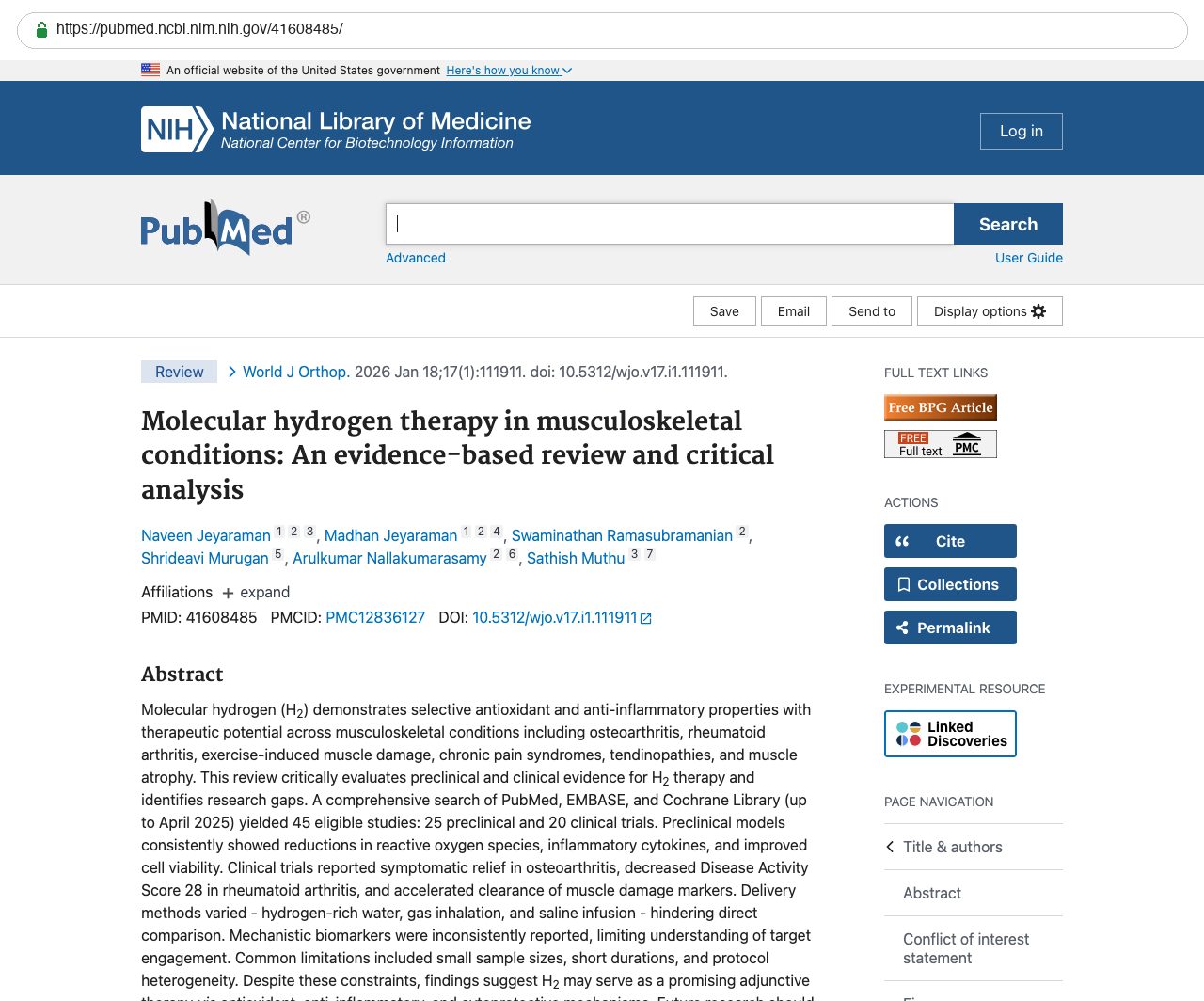
This page mirrors the published abstract (© the authors / publisher) for reference and citation. The canonical source is the PubMed record linked above. This is not medical advice.