2018 Antioxidants (Basel, Switzerland) RCT Human H₂ therapy Bath / Topical Sports & ExerciseImmune / Inflammation
2018 · Kawamura et al. — Involvement of Neutrophil Dynamics and Function in Exercise-Induced Muscle Damage and Delayed-Onset Muscle Soreness: Effect of Hydrogen Bath
Super-Abstract
In nine healthy young men, a daily hydrogen bath for one week after downhill running showed no effect on muscle soreness, neutrophil counts and function, muscle damage or inflammation markers compared with a placebo bath. The main finding concerned the exercise itself: plasma IL-6 after the run correlated with neutrophil count, muscle soreness and creatine kinase activity. Per full text, the crossover trial was randomised and single-blind, and the exercise load was lower than the authors expected. (Antioxidants, 2018.)
Commentary
The study examined how neutrophils are involved in exercise-induced muscle damage and delayed-onset muscle soreness, and whether a hydrogen bath affects these processes. Per full text, the bath effect was the secondary aim. Nine healthy, active young men completed a hydrogen bath trial and a placebo bath trial in a crossover design. Per full text, the study was randomised, placebo-controlled and single-blind, and ten men took part, one of whom was excluded from analysis. Each trial began with 30 minutes of downhill running at an -8% slope at a speed set to 75 to 85% of peak oxygen uptake, followed by baths of 20 minutes a day for one week. Per full text, the hydrogen bath contained 2.5 g of magnesium hydride in 200 L of hot water and the placebo bath 5.5 g of magnesium hydroxide. No hydrogen concentration is reported. Outcomes were muscle soreness on a visual analogue scale, leukocyte counts, neutrophil dynamics and function, and muscle damage and inflammation markers.
Key quotes
- „Conversely, there were no effects of H₂ bath.“ — the null result for the hydrogen bath, stated without qualification
- „Plasma interleukin (IL)-6 concentration was significantly correlated with peripheral neutrophil count, VAS, and serum creatine kinase activity, respectively, after downhill running.“ — the main finding, which concerns the exercise response rather than hydrogen
- „it is not likely that H₂ bath is effective for the inflammatory process that was centered on neutrophils after downhill running.“ — the authors' conclusion on the hydrogen bath
Our assessment
Because of the crossover design, each man served as his own control. The hydrogen bath showed no effect on soreness, neutrophils, muscle damage or inflammation markers. The correlations between IL-6, neutrophils and soreness describe the response to exercise, not an effect of hydrogen. Limitations: only nine analysed participants, all healthy young men, so small effects could be missed and the results cannot be extended to women, older people or patients. The abstract mentions neither randomisation nor blinding. Per full text, the trial was randomised and single-blind. No hydrogen concentration in the bath is reported, and per full text the baths from the second day on were taken at home. The authors also write in the full text that the exercise load was lower than expected (56.0% and 56.7% of peak oxygen uptake) and may have been too weak a stimulus. Within these limits, the study found no sign that a hydrogen bath changes the neutrophil-centred inflammation after downhill running.
Study design
- Type: placebo-controlled crossover trial, per full text randomised and single-blind · n: nine healthy young men analysed (per full text 10 enrolled, 1 excluded) · H₂ delivery: whole-body hydrogen bath, 20 minutes a day for one week after downhill running, per full text 2.5 g magnesium hydride in 200 L of water, hydrogen concentration not reported
- Comparator: placebo bath, per full text 5.5 g magnesium hydroxide, same schedule, with at least one week between trials
- Result: no effect of the hydrogen bath on muscle soreness, leukocyte counts, neutrophil dynamics and function, muscle damage or inflammation markers (no figures for the bath comparison in the abstract). After downhill running, plasma IL-6 correlated with neutrophil count, soreness and creatine kinase activity, and neutrophil count correlated with serum myoglobin
Abstract
The purpose of this study was to investigate the involvement of neutrophil dynamics and function in exercise-induced muscle damage (EIMD) and delayed-onset muscle soreness (DOMS), and the effect of molecular hydrogen (H₂) intake on these parameters. Nine healthy and active young men performed H₂ and placebo bath trial in a crossover design. They carried out downhill running (-8% slope) for 30 min at a speed corresponding to 75~85% of peak oxygen uptake (VO₂peak). Subsequently, they repeated bathing for 20 min per day for one week. Degree of muscle soreness (visual analogue scale: VAS), peripheral leukocyte counts, neutrophil dynamics and function, muscle damage, and inflammation markers were measured. Plasma interleukin (IL)-6 concentration was significantly correlated with peripheral neutrophil count, VAS, and serum creatine kinase activity, respectively, after downhill running. Peripheral neutrophil count and serum myoglobin concentration were also significantly correlated. Conversely, there were no effects of H₂ bath. These results suggest that IL-6 may be involved in the mobilization of neutrophils into the peripheral blood and subsequent EIMD and DOMS after downhill running; however, it is not likely that H₂ bath is effective for the inflammatory process that was centered on neutrophils after downhill running.
Source & links
Screenshot of the PubMed page
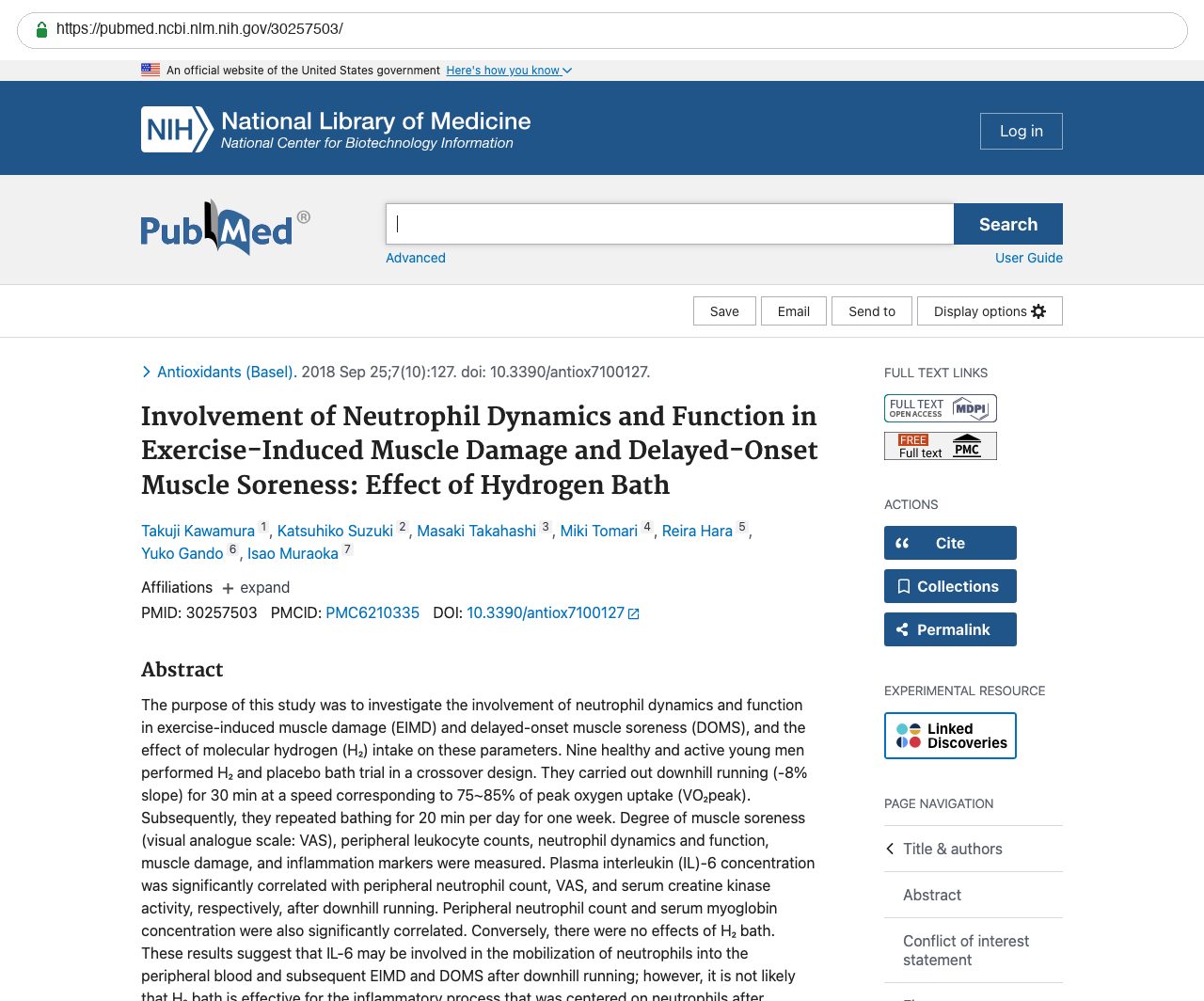
This page mirrors the published abstract (© the authors / publisher) for reference and citation. The canonical source is the PubMed record linked above. This is not medical advice.