2019 · LeBaron et al. — Acute Supplementation with Molecular Hydrogen Benefits Submaximal Exercise Indices. Randomized, Double-Blinded, Placebo-Controlled Crossover Pilot Study
Super-Abstract
In 19 healthy adults, hydrogen-producing tablets taken the day before and the day of a treadmill test to exhaustion did not change maximal or minimal exercise values compared with placebo, but average heart rate and breathing rate during exercise were lower. In minutes 1 to 9 of the test, heart rate averaged 121 bpm with hydrogen compared with 126 bpm with placebo and 124 bpm at baseline (p < 0.001), without a substantial change in oxygen uptake. Per full text, the effect sizes of the comparisons in minutes 1 to 9 were small (Cohen's d < 0.14), and the abstract names no primary endpoint. (Journal of Lifestyle Medicine, 2019.)
Commentary
Hydrogen-rich water has been reported to have ergogenic effects, and this pilot study tested whether short-term intake changes heart rate and breathing measures during exercise. Nineteen healthy adults (4 women, 15 men) first completed a baseline graded treadmill test to exhaustion. They then completed two more tests in a randomised, double-blind, placebo-controlled crossover, taking either hydrogen-producing tablets or placebo the day before and the day of testing. According to the abstract, the tablets delivered 5 mg of H₂. Per full text, the tablets were given in capsules that looked identical to the placebo capsules, which contained magnesium salts instead of metallic magnesium, and tests were at least four days apart. Oxygen uptake (VO2), respiratory exchange ratio (RER), heart rate and respiratory rate were recorded and compared with Bonferroni-adjusted pairwise comparisons. The abstract does not name a primary endpoint.
Key quotes
- „HRW decreased exercising HR during minutes 1-9 of the graded exercise test (121 ± 26 bpm) compared to placebo (126 ± 26 bpm) and baseline (124 ± 27 bpm) (p < 0.001) without substantially influencing VO2.“ — the main heart rate result in the early, submaximal part of the test
- „HRW supplementation did not influence maximal or minimal indices of exercise performance (VO2, RER, HR and RR) (p < 0.05).“ — no effect on maximal or minimal values, the full text gives p > 0.05
- „Further studies are needed to determine the influence and practical significance of HRW on varying exercise intensities as well as optimal dosing protocols and the effects of chronic use.“ — the authors' call for studies on intensity, dose and long-term use
Our assessment
The crossover is randomised, double-blind and placebo-controlled, and the abstract reports a Bonferroni adjustment for multiple comparisons. Maximal and minimal exercise values did not change, while average heart rate during exercise was lower with hydrogen. In minutes 1 to 9, heart rate was 5 bpm lower than with placebo but only 3 bpm lower than at baseline, against standard deviations of 26 to 27 bpm. Per full text, the effect sizes of these minute 1 to 9 comparisons were small (Cohen's d < 0.14). Limitations: pilot study with 19 participants, a single short supplementation period and physiological measures instead of performance outcomes. Per full text, the baseline test always came first and was not part of the randomisation. The abstract states the null result for maximal values with p < 0.05, which reads as a typo for p > 0.05 given in the full text. No primary endpoint is named, and adverse events are not reported.
Study design
- Type: randomised, double-blind, placebo-controlled crossover pilot study after a baseline test · n: 19 (4 women, 15 men) · H₂ delivery: hydrogen-producing tablets taken the day before and the day of testing, 5 mg of H₂ according to the abstract, per full text given in capsules
- Comparator: placebo capsules (per full text identical in appearance, with magnesium salts instead of metallic magnesium), plus an initial baseline test without supplement
- Result: no primary endpoint named. Maximal and minimal VO2, RER, heart rate and respiratory rate unchanged. Average exercising heart rate and respiratory rate lower with hydrogen (p < 0.05). Heart rate in minutes 1 to 9: 121 ± 26 bpm vs. 126 ± 26 bpm (placebo) and 124 ± 27 bpm (baseline), p < 0.001. Per full text, effect sizes of the minute 1 to 9 comparisons small (Cohen's d < 0.14)
Abstract
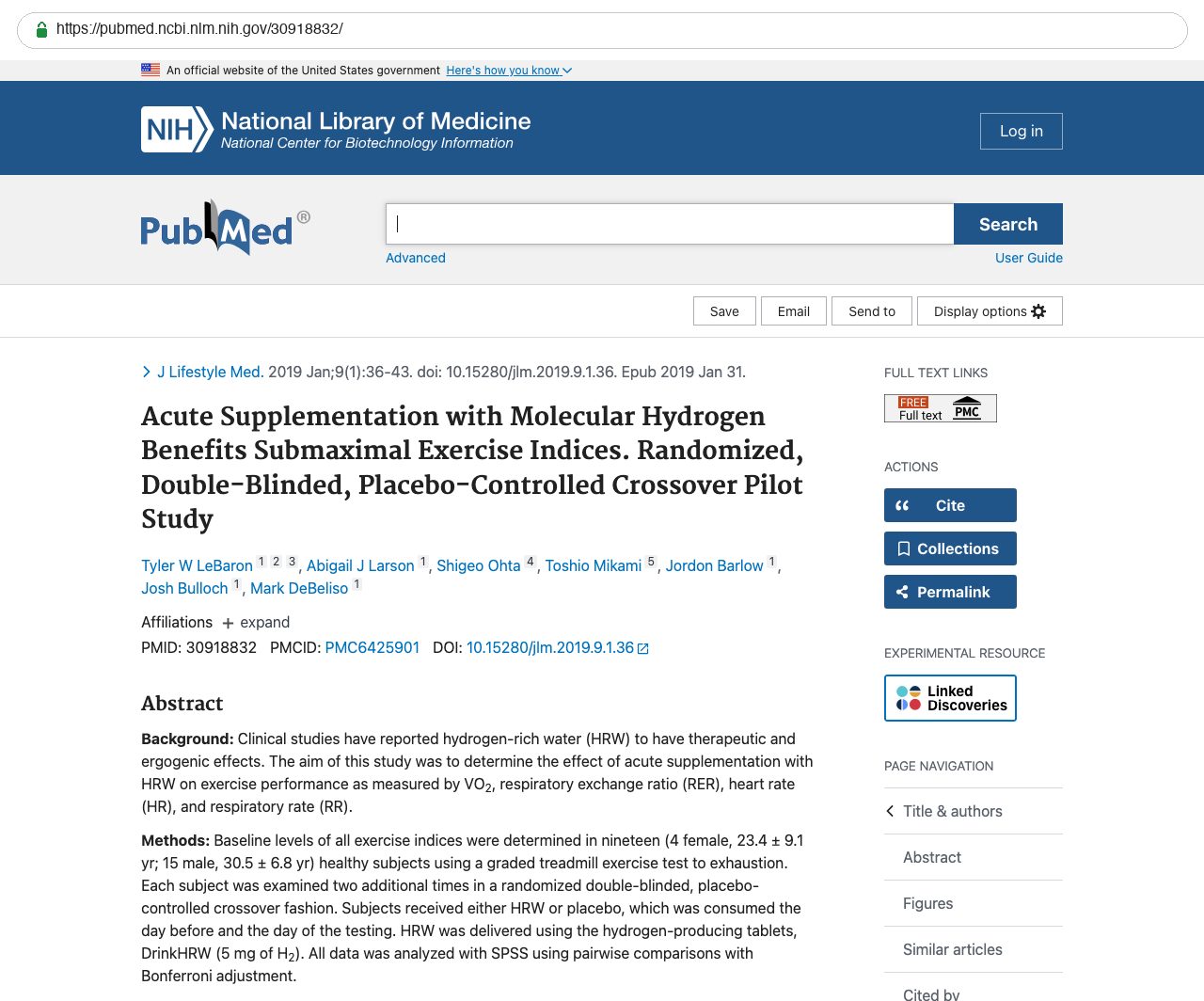
BACKGROUND: Clinical studies have reported hydrogen-rich water (HRW) to have therapeutic and ergogenic effects. The aim of this study was to determine the effect of acute supplementation with HRW on exercise performance as measured by VO2, respiratory exchange ratio (RER), heart rate (HR), and respiratory rate (RR). METHODS: Baseline levels of all exercise indices were determined in nineteen (4 female, 23.4 ± 9.1 yr; 15 male, 30.5 ± 6.8 yr) healthy subjects using a graded treadmill exercise test to exhaustion. Each subject was examined two additional times in a randomized double-blinded, placebo-controlled crossover fashion. Subjects received either HRW or placebo, which was consumed the day before and the day of the testing. HRW was delivered using the hydrogen-producing tablets, DrinkHRW (5 mg of H2). All data was analyzed with SPSS using pairwise comparisons with Bonferroni adjustment. RESULTS: HRW supplementation did not influence maximal or minimal indices of exercise performance (VO2, RER, HR and RR) (p < 0.05). However, HRW significantly decreased average exercising RR and HR (p < 0.05). HRW decreased exercising HR during minutes 1-9 of the graded exercise test (121 ± 26 bpm) compared to placebo (126 ± 26 bpm) and baseline (124 ± 27 bpm) (p < 0.001) without substantially influencing VO2. CONCLUSION: Acute supplementation of DrinkHRW tablets may benefit submaximal aerobic exercise performance by lowering exercising HR. Further studies are needed to determine the influence and practical significance of HRW on varying exercise intensities as well as optimal dosing protocols and the effects of chronic use.
Source & links
Screenshot of the PubMed page
This page mirrors the published abstract (© the authors / publisher) for reference and citation. The canonical source is the PubMed record linked above. This is not medical advice.