2020 Diabetes, metabolic syndrome and obesity : targets and therapy RCT Human H₂ therapy Drinking (HRW) MetabolicCardiovascular
2020 · LeBaron et al. — The Effects of 24-Week, High-Concentration Hydrogen-Rich Water on Body Composition, Blood Lipid Profiles and Inflammation Biomarkers in Men and Women with Metabolic Syndrome: A Randomized Controlled Trial
Super-Abstract
In 60 adults with metabolic syndrome, 24 weeks of high-concentration hydrogen-rich water (more than 5.5 millimoles of H₂ per day) significantly lowered blood cholesterol, glucose and haemoglobin A1c and improved inflammation and redox markers compared with placebo. Body mass index and waist-to-hip ratio showed only a trend toward a mild reduction. The abstract gives no group values, effect sizes or primary endpoint, so the size of the changes cannot be judged. (Diabetes, Metabolic Syndrome and Obesity, 2020.)
Commentary
Metabolic syndrome combines risk factors such as dyslipidaemia, high blood glucose and obesity, and raises the risk of cardiovascular and neurological disease. The authors tested whether long-term intake of high-concentration hydrogen-rich water changes these risk factors. In a randomised, double-blind, placebo-controlled trial, 60 people with metabolic syndrome (30 men, 30 women) were first observed for one week to collect baseline data. They were then randomised to placebo or to water providing more than 5.5 millimoles of H₂ per day for 24 weeks. According to the title, outcomes included body composition, blood lipid profiles and inflammation biomarkers. The results also mention blood glucose, haemoglobin A1c and markers of redox homeostasis. The abstract does not state the daily volume of water, the placebo composition, the group sizes after randomisation, a primary endpoint, dropouts or adverse events.
Key quotes
- „Supplementation with high-concentration HRW significantly reduced blood cholesterol and glucose levels, attenuated serum hemoglobin A1c, and improved biomarkers of inflammation and redox homeostasis as compared to placebo (P < 0.05).“ — the main result, reported without effect sizes or group values
- „Furthermore, H2 tended to promote a mild reduction in body mass index and waist-to-hip ratio.“ — body measures changed only as a trend, not as a significant result
- „Our results give further credence that high-concentration HRW might have promising effects as a therapeutic modality for attenuating risk factors of metabolic syndrome.“ — the authors' conclusion, worded cautiously with might
Our assessment
This is a randomised, double-blind, placebo-controlled trial lasting 24 weeks. The abstract, however, reports only that several blood markers differed from placebo with P below 0.05. It gives no group means, effect sizes, confidence intervals or the number of participants who completed the trial, so the size and clinical relevance of the changes cannot be judged. Body mass index and waist-to-hip ratio showed only a trend. Limitations: 60 participants, no named primary endpoint, many blood markers tested, surrogate markers instead of clinical events, and no information on adverse events, dropouts or the placebo in the abstract. The authors word their conclusion cautiously and say the water might have effects on risk factors of metabolic syndrome. Confirmation with fully reported results is needed.
Study design
- Type: randomised, double-blind trial with placebo, 24 weeks after a baseline week · n: 60 (30 men, 30 women) with metabolic syndrome · H₂ delivery: drinking water with a high hydrogen concentration, more than 5.5 millimoles of H₂ per day
- Comparator: placebo (composition not described in the abstract)
- Result: no primary endpoint named. Compared with placebo: lower blood cholesterol and glucose, lower haemoglobin A1c, improved inflammation and redox markers (P below 0.05, no values given). Body mass index and waist-to-hip ratio: trend toward a mild reduction
Abstract
PURPOSE: Metabolic syndrome is associated with several medical risk factors including dyslipidemia, hyperglycemia, and obesity, which has become a worldwide pandemic. The sequelae of this condition increase the risk of cardiovascular and neurological disease and increased mortality. Its pathophysiology is associated with redox dysregulation, excessive inflammation, and perturbation of cellular homeostasis. Molecular hydrogen (H2) may attenuate oxidative stress, improve cellular function, and reduce chronic inflammation. Pre-clinical and clinical studies have shown promising effects of H2-rich water (HRW) on specific features of metabolic syndrome, yet the effects of long-term, high-concentration HRW in this prevalent condition remain poorly addressed. METHODS: We conducted a randomized, double-blinded, placebo-controlled trial in 60 subjects (30 men and 30 women) with metabolic syndrome. An initial observation period of one week was used to acquire baseline clinical data followed by randomization to either placebo or high-concentration HRW (> 5.5 millimoles of H2 per day) for 24 weeks. RESULTS: Supplementation with high-concentration HRW significantly reduced blood cholesterol and glucose levels, attenuated serum hemoglobin A1c, and improved biomarkers of inflammation and redox homeostasis as compared to placebo (P < 0.05). Furthermore, H2 tended to promote a mild reduction in body mass index and waist-to-hip ratio. CONCLUSION: Our results give further credence that high-concentration HRW might have promising effects as a therapeutic modality for attenuating risk factors of metabolic syndrome.
Source & links
Screenshot of the PubMed page
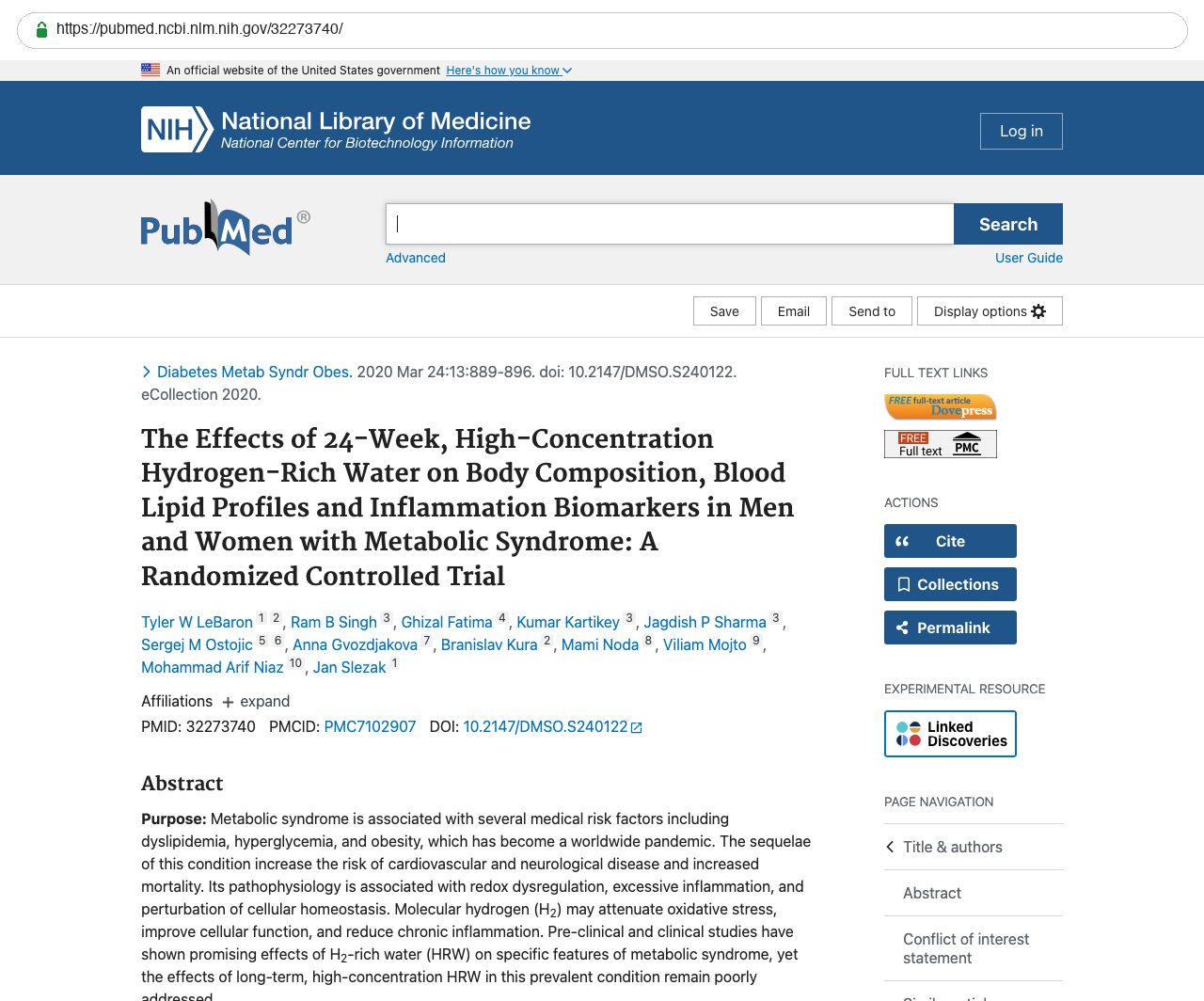
This page mirrors the published abstract (© the authors / publisher) for reference and citation. The canonical source is the PubMed record linked above. This is not medical advice.