2015 The Journal of clinical endocrinology and metabolism RCT Human H₂ therapy Drinking (HRW) CardiovascularMetabolic
2015 · Song et al. — Hydrogen Activates ATP-Binding Cassette Transporter A1-Dependent Efflux Ex Vivo and Improves High-Density Lipoprotein Function in Patients With Hypercholesterolemia: A Double-Blinded, Randomized, and Placebo-Controlled Trial
Super-Abstract
In 68 patients with untreated high cholesterol randomised to hydrogen-rich water (0.9 L a day) or placebo water for 10 weeks, the hydrogen group showed improved laboratory measures of HDL function, including cholesterol efflux tested ex vivo, while plasma HDL cholesterol did not change. The 'effective rate' for lowering total cholesterol was 47.06% with hydrogen compared with 17.65% with placebo, and for LDL cholesterol 47.06% compared with 23.53%, but the abstract does not define this rate. The abstract names no primary endpoint, gives no p-values and does not report adverse events. It also calls the trial a case-control study, which conflicts with its description as randomised. (J Clin Endocrinol Metab, 2015.)
Commentary
An earlier before-after study by the same group had reported lower LDL cholesterol and better HDL function with hydrogen in people with possible metabolic syndrome. This trial in the Zhoudian community of Tai'an, China, randomly allocated 68 patients with untreated isolated hypercholesterolaemia to hydrogen-rich water (n = 34) or placebo water (n = 34), 0.9 L a day for 10 weeks. The title describes it as double-blinded and placebo-controlled. The abstract does not give the hydrogen concentration, a primary endpoint or the number of participants who completed. Outcomes included plasma lipids and lipoproteins and laboratory tests of HDL function: ATP-binding cassette transporter A1 (ABCA1)-mediated cholesterol efflux, pre-β-HDL, protection against LDL oxidation, inhibition of oxidised-LDL-induced inflammation and protection of endothelial cells from oxidised-LDL-induced apoptosis. Apolipoproteins were analysed by Western blot, and inflammatory and oxidative stress indicators were measured in plasma and HDL particles.
Key quotes
- „HDL isolated from the H2 group showed an increased ability to promote the ATP-binding cassette transporter A1-mediated cholesterol efflux ex vivo.“ — the main laboratory finding, measured outside the body in isolated HDL
- „Plasma pre-β-HDL levels were up-regulated although there were no changes in plasma HDL-cholesterol levels.“ — HDL cholesterol itself did not change
- „H2 activates ATP-binding cassette transporter A1-dependent efflux, enhances HDL antiatherosclerotic functions, and has beneficial lipid-lowering effects.“ — the authors' conclusion, drawn from laboratory and blood markers
Our assessment
The trial randomised 68 patients to hydrogen-rich water or placebo water and examined HDL in detail in the laboratory. It suggests changes in markers of HDL function, but plasma HDL cholesterol did not change, and the abstract reports no outcomes on atherosclerosis or cardiovascular events. The authors' remark about a potential role in the regression of atherosclerosis is not tested by this design. Limitations: 68 participants from one community and 10 weeks of treatment. The abstract names no primary endpoint, gives no p-values or effect sizes beyond the response rates, and does not define the 'effective rate'. It describes the design as a case-control study, which contradicts the randomised, placebo-controlled description in the title and objective. Many laboratory outcomes were tested. Hydrogen concentration, dropouts and adverse events are not reported in the abstract.
Study design
- Type: randomised, double-blind, placebo-controlled trial according to title and objective (the abstract also calls it a case-control study), community setting in Tai'an, China, 10 weeks · n: 68 (34 hydrogen water, 34 placebo water) · H₂ delivery: drinking hydrogen-rich water, 0.9 L per day (concentration not stated in the abstract)
- Comparator: placebo water
- Result: no primary endpoint named. HDL from the hydrogen group promoted more ABCA1-mediated cholesterol efflux ex vivo, pre-β-HDL rose, plasma HDL cholesterol did not change. HDL protection against LDL oxidation, inflammation and endothelial cell apoptosis reported as significantly improved. Effective rate for lowering total cholesterol 47.06% vs. 17.65%, for LDL cholesterol 47.06% vs. 23.53%. Lower apolipoprotein B100, higher apolipoprotein M
Abstract
CONTEXT: We have found that hydrogen (dihydrogen [H2]) decreases plasma low-density lipoprotein (LDL) cholesterol levels and improves high-density lipoprotein (HDL) function in patients with potential metabolic syndrome in a before-after self-controlled study. OBJECTIVE: The purpose of this study was to further characterize the effects of H2-rich water (0.9 L/day) on the content, composition, and biological activities of plasma lipoproteins on patients with hypercholesterolemia and their underlying mechanisms in a double-blinded, randomized, and placebo-controlled trial. DESIGN: This was a case-control study. SETTING: The setting was the Zhoudian community, Tai'an, China. PATIENTS: A total of 68 patients with untreated isolated hypercholesterolemia were randomly allocated to either drinking H2-rich water (n = 34) or placebo water (n = 34) for 10 weeks. RESULTS: HDL isolated from the H2 group showed an increased ability to promote the ATP-binding cassette transporter A1-mediated cholesterol efflux ex vivo. Plasma pre-β-HDL levels were up-regulated although there were no changes in plasma HDL-cholesterol levels. Moreover, other HDL functions, assessed in protection against LDL oxidation, inhibition of oxidized-LDL-induced inflammation, and protection of endothelial cells from oxidized-LDL-induced apoptosis, were all significantly improved by H2 treatment. In addition, H2 treatment increased the effective rate in down-regulating plasma levels of total cholesterol (47.06% vs 17.65%) and LDL cholesterol (47.06% vs 23.53%). Western blot analysis revealed a marked decrease in apolipoprotein B100 and an increase in apolipoprotein M in plasma of the H2 group. Finally H2 treatment resulted in a significant reduction in the levels of several inflammatory and oxidative stress indicators in whole plasma and HDL particles. CONCLUSIONS: H2 activates ATP-binding cassette transporter A1-dependent efflux, enhances HDL antiatherosclerotic functions, and has beneficial lipid-lowering effects. The present findings highlight the potential role of H2 in the regression of hypercholesterolemia and atherosclerosis.
Source & links
Screenshot of the PubMed page
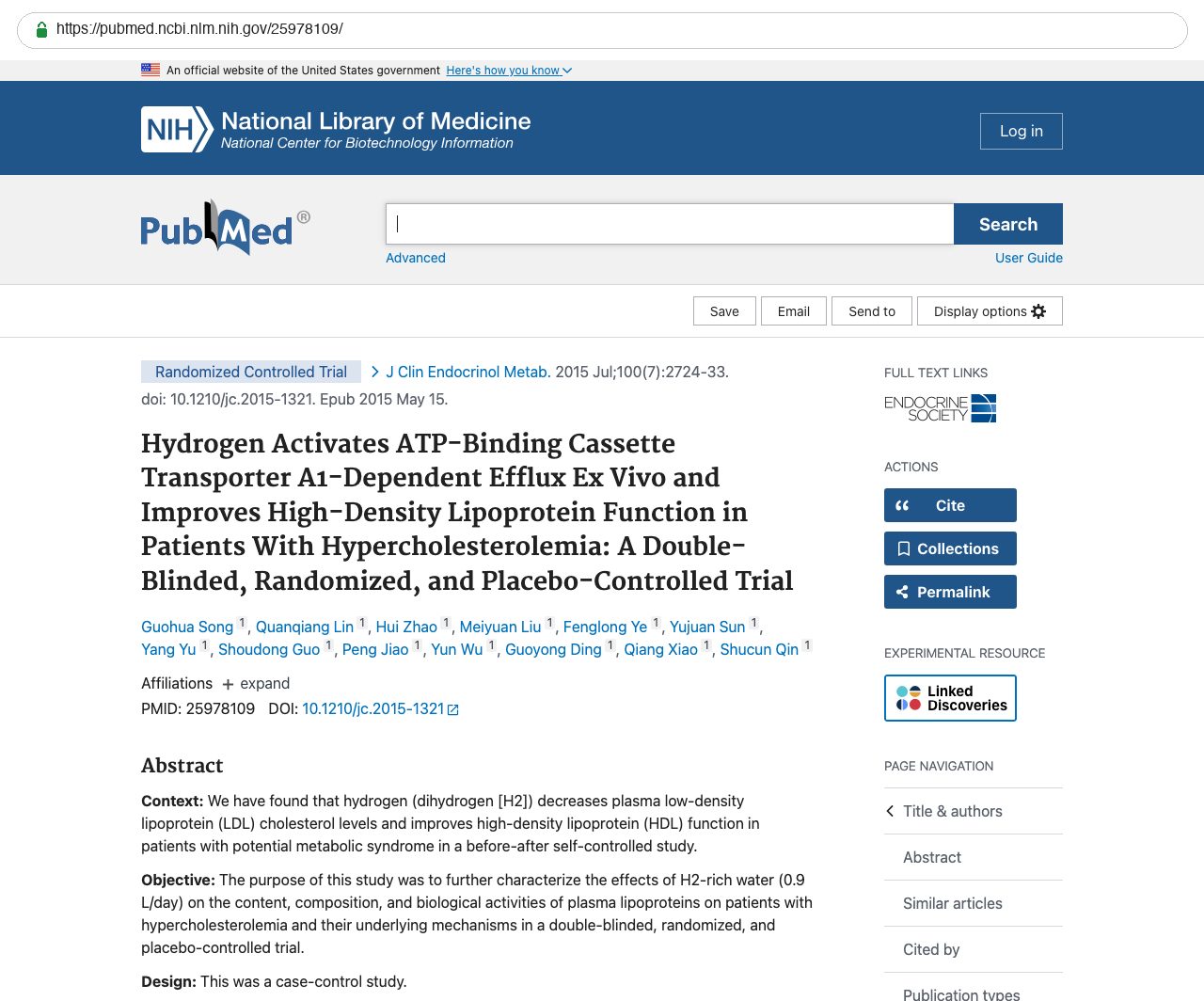
This page mirrors the published abstract (© the authors / publisher) for reference and citation. The canonical source is the PubMed record linked above. This is not medical advice.