2026 Canadian journal of physiology and pharmacology RCT Human H₂ therapy Drinking (HRW) Cardiovascular
2026 · Muramoto et al. — Hydrogen-Rich Jelly Exhibits a Positive Effect on Heart Rate Variability During Orthostatic Loading in Healthy Adults: A Randomized Crossover Trial
Super-Abstract
In 50 healthy adults, hydrogen-rich jelly taken before a test of standing up from a seated position showed no statistically significant difference from placebo in the primary endpoint, high-frequency heart rate variability. Exploratory analyses found a lower coefficient of variation of the R-R interval while standing up (p = 0.047) and a lower low-frequency-to-high-frequency ratio while sitting down again (p = 0.027), with no differences at rest or during standing. The authors describe these changes as mild and of uncertain physiological and clinical significance. (Canadian Journal of Physiology and Pharmacology, 2026.)
Commentary
Hydrogen gas may improve autonomic regulation, but the effect of hydrogen-rich jelly on autonomic responses during changes in posture had not been studied. This double-blind, randomised, placebo-controlled crossover trial included 50 healthy adults (21 men, mean age 44.2 ± 11.3 years). Hydrogen-rich jelly (30–40 ppm, 10 g) or placebo was taken by mouth 24 hours, 1.5 hours and immediately before testing. Heart rate variability (HRV) was recorded during an orthostatic loading protocol with four 1-minute phases: seated rest, standing up, standing and sitting down again. The primary endpoint was the high-frequency (HF) component of HRV. Exploratory analyses covered the coefficient of variation of the R-R interval (CVRR) and the low-frequency-to-high-frequency (L/H) ratio, plus subgroups by sex, skeletal muscle mass, age, body mass index and alcohol use. Complete data were available for 48 participants. The abstract does not state the washout period between the two arms or report adverse events.
Key quotes
- „Among the 48 participants with complete data, no significant difference in the primary endpoint of high-frequency was observed.“ — the primary endpoint showed no difference between hydrogen jelly and placebo
- „Exploratory analyses revealed lower coefficient of variation of the R-R interval (CVRR) during the stand-up phase (mean difference: -0.46, p = 0.047) and lower low-frequency-to-high-frequency (L/H) ratio during the resitting phase (mean difference: -1.51, p = 0.027), with no significant differences at rest or during standing.“ — exploratory findings limited to two of the four test phases
- „HRJ may induce mild, stage-specific changes in HRV during postural transitions. However, their physiological and clinical significance remains uncertain and should be clarified in future studies.“ — the authors' cautious conclusion on what the changes mean
Our assessment
The design is strong for its size: double-blind, placebo-controlled and crossover, so each participant served as their own control. The primary endpoint, high-frequency HRV, did not differ between hydrogen-rich jelly and placebo. The positive signals come from exploratory analyses in two of the four test phases, with p-values of 0.047 and 0.027, and from subgroup analyses. With this many comparisons, some significant results can arise by chance. The title's claim of a positive effect therefore rests on secondary findings. Limitations: healthy volunteers only, short 1-minute recording phases, and HRV as a surrogate measure rather than a clinical outcome. The abstract gives no washout period, no adverse event data and no information on correction for multiple testing. The authors themselves call the physiological and clinical significance uncertain.
Study design
- Type: double-blind, randomised, placebo-controlled crossover trial · n: 50 healthy adults (21 men, mean age 44.2 years), 48 with complete data · H₂ delivery: hydrogen-rich jelly by mouth, 10 g at 30–40 ppm, taken 24 hours, 1.5 hours and immediately before testing
- Comparator: placebo on the same schedule
- Result: primary endpoint (high-frequency HRV): no significant difference. Exploratory: CVRR lower during stand-up (mean difference −0.46, p = 0.047), L/H ratio lower during resitting (mean difference −1.51, p = 0.027), no differences at rest or while standing. Subgroups: stronger CVRR response in women and people with lower skeletal muscle mass, stronger L/H response in younger participants, those with higher body mass index and habitual alcohol drinkers
Abstract
Hydrogen gas may improve autonomic regulation. The effects of hydrogen-rich jelly (HRJ) on autonomic responses during postural transition have not yet been investigated. This double-blind, randomized, placebo-controlled crossover trial evaluated HRJ effects on heart rate variability (HRV) in 50 healthy adults (21 men; mean age, 44.2 ± 11.3 years). HRJ (30-40 ppm, 10 g) or placebo was orally administered 24 h, 1.5 h, and immediately before testing. HRV was recorded during an orthostatic loading protocol with four 1 min phases: seated rest, stand-up, standing, and resitting. Among the 48 participants with complete data, no significant difference in the primary endpoint of high-frequency was observed. Exploratory analyses revealed lower coefficient of variation of the R-R interval (CVRR) during the stand-up phase (mean difference: -0.46, p = 0.047) and lower low-frequency-to-high-frequency (L/H) ratio during the resitting phase (mean difference: -1.51, p = 0.027), with no significant differences at rest or during standing. Subgroup analyses suggested stronger responses in women and those with lower skeletal muscle mass (CVRR), and in younger participants, those with higher body mass index, and habitual alcohol consumption (L/H). HRJ may induce mild, stage-specific changes in HRV during postural transitions. However, their physiological and clinical significance remains uncertain and should be clarified in future studies.
Source & links
Screenshot of the PubMed page
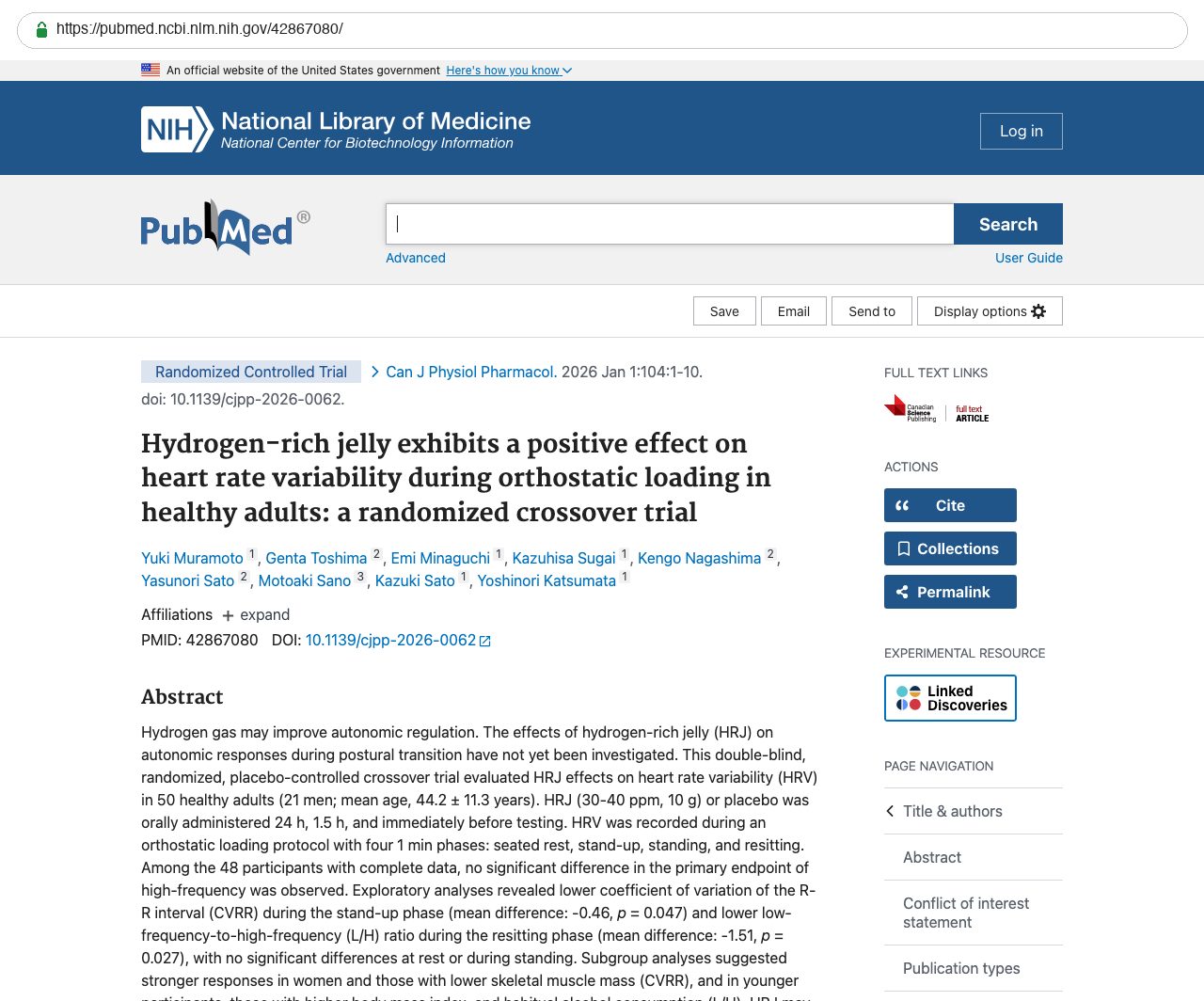
This page mirrors the published abstract (© the authors / publisher) for reference and citation. The canonical source is the PubMed record linked above. This is not medical advice.