2021 · Timón et al. — Effects of 7-Day Intake of Hydrogen-Rich Water on Physical Performance of Trained and Untrained Subjects
Super-Abstract
In a double-blind crossover study with 37 volunteers, 7 days of hydrogen-rich water raised peak and mean power and lowered the fatigue index in a maximal anaerobic test compared with placebo water, but only in trained cyclists and not in untrained participants. Effect sizes in the trained cyclists were d = .51 for peak and mean power and d = .45 for the fatigue index. The abstract gives no p-values and no aerobic results. Per full text, VO2max, maximal work rate and time to exhaustion did not differ between the two waters, and there was no washout between the two intake weeks. (Biology of Sport, 2021.)
Commentary
Hydrogen-rich water is used by athletes to improve performance and reduce fatigue, and this study asked whether training status changes its effect. Thirty-seven volunteers took part in two groups, trained cyclists and untrained subjects. Per full text, the groups comprised 12 cyclists and 15 untrained participants, which adds up to 27, not 37. In a double-blind crossover design, everyone drank placebo water for one week and hydrogen-rich water with nano-bubbles (1.9 ppm hydrogen, pH 7.5, redox potential -600 mV) for another. Per full text, the order was randomised, participants drank 1920 to 2240 ml per day, and there was no washout between the two weeks. After each 7-day phase, performance was measured with an incremental VO2max test and a maximal anaerobic test that recorded peak power, mean power and fatigue index. The abstract does not name a primary endpoint.
Key quotes
- „After HRW intake, only trained cyclists improved their performance in the anaerobic test with an increase in peak power (from 766.2 ± 125.6 to 826.5 ± 143.4 W; d = .51) and mean power (from 350.0 ± 53.5 to 380.2 ± 71.3 W; d = .51), and a decrease in the fatigue index (from 77.6 ± 5.8 to 75.1 ± 5.9%; d = .45).“ — the main result, limited to trained cyclists in the anaerobic test
- „A double-blind crossover design was performed in which all subjects took a placebo (PW) and nano-bubble HRW (pH: 7.5; hydrogen concentration: 1.9 ppm; oxidation-reduction potential (ORP): -600 mV).“ — the design and the hydrogen concentration of the water
- „The findings demonstrate that the ergogenic effect of HRW is mediated by the training status, and that 7-day intake of HRW would be an effective strategy for improving anaerobic performance in trained cyclists.“ — the authors' conclusion, based on the trained subgroup only
Our assessment
The crossover design compares each participant's two water phases, and per full text the order was randomised and both waters looked alike. Only trained cyclists improved in the anaerobic test, and untrained participants showed no clear effect. Per full text, the effect in cyclists rests on interactions between water and training status with p-values of .046 to .049, while the overall water effect on peak power, mean power and fatigue index was not statistically significant. Also per full text, VO2max, maximal work rate, time to exhaustion, maximum heart rate and perceived exertion did not differ between waters. Limitations: small groups, a stated total of 37 that does not match the group sizes in the full text, no washout between phases, only 7 days of intake and no named primary endpoint. Many outcomes were tested across two groups. Per full text, no oxidative stress markers were measured, and no participant reported adverse effects related to the water.
Study design
- Type: double-blind, placebo-controlled crossover study (randomised order per full text), no washout · n: 37 (trained cyclists and untrained subjects, per full text 12 and 15) · H₂ delivery: water with nano-bubbles and 1.9 ppm hydrogen for 7 days, per full text 1920 to 2240 ml per day
- Comparator: placebo water (per full text 0 ppm hydrogen, from a similar bottle)
- Result: no primary endpoint named. Trained cyclists, anaerobic test: peak power 766.2 vs. 826.5 W (d = .51), mean power 350.0 vs. 380.2 W (d = .51), fatigue index 77.6 vs. 75.1% (d = .45). Interaction p = .046 to .049 per full text. Untrained: no clear effect. Per full text no difference in VO2max, maximal work rate, time to exhaustion, maximum heart rate or perceived exertion. Lactate after the incremental test lower in trained cyclists (interaction p = .043, d = .33)
Abstract
Hydrogen-rich water (HRW) is used as a supplement to improve performance and reduce fatigue in athletes. However, the potentially beneficial effects of HRW intake could be mediated by the training status of athletes. The purpose of the study was to analyse the ergogenic effect of intake of HRW for one week on aerobic and anaerobic performance, both in trained and untrained individuals. Thirty-seven volunteers participated in the study and were divided into two experimental groups: trained cyclists and untrained subjects. A double-blind crossover design was performed in which all subjects took a placebo (PW) and nano-bubble HRW (pH: 7.5; hydrogen concentration: 1.9 ppm; oxidation-reduction potential (ORP): -600 mV). At the end of 7-day intake, performance was assessed by an incremental VO2max test and by a maximum anaerobic test. After HRW intake, only trained cyclists improved their performance in the anaerobic test with an increase in peak power (from 766.2 ± 125.6 to 826.5 ± 143.4 W; d = .51) and mean power (from 350.0 ± 53.5 to 380.2 ± 71.3 W; d = .51), and a decrease in the fatigue index (from 77.6 ± 5.8 to 75.1 ± 5.9%; d = .45). The findings demonstrate that the ergogenic effect of HRW is mediated by the training status, and that 7-day intake of HRW would be an effective strategy for improving anaerobic performance in trained cyclists.
Source & links
Screenshot of the PubMed page
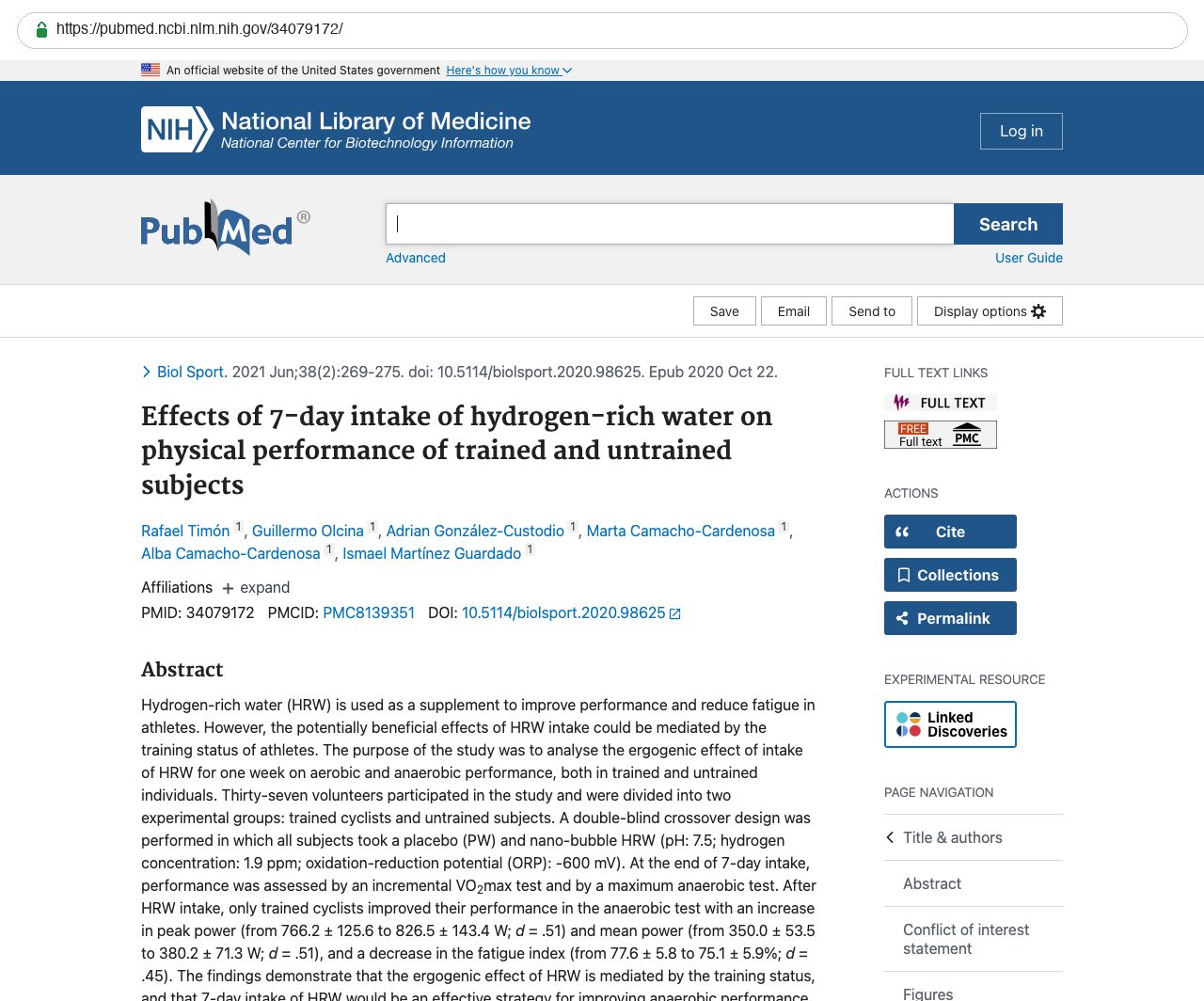
This page mirrors the published abstract (© the authors / publisher) for reference and citation. The canonical source is the PubMed record linked above. This is not medical advice.