2026 · Wang et al. — A Systematic Review of the Effectiveness of Hydrogen Therapy in Hearing Loss
Super-Abstract
This systematic review included 11 studies of hydrogen therapy for hearing loss in humans or animals and reports protective effects in noise- and drug-induced hearing loss models plus improved hearing in two clinical settings, without pooling the data. Per full text, only three of the studies were in humans: an uncontrolled study of 17 patients with hearing loss after radiotherapy, a report on 3 such patients, and one randomised double-blind trial in 65 patients with sudden hearing loss. The authors rated the animal studies at high risk of bias, and differences between studies ruled out a meta-analysis. (Noise & Health, 2026.)
Commentary
H₂ has antioxidant and anti-inflammatory properties, but consolidated evidence on its use in hearing loss has been lacking. Following PRISMA guidelines, the authors searched PubMed, MEDLINE and DOAJ up to March 1, 2025 for studies of H₂ in noise-induced, drug-induced or radiotherapy-induced hearing loss and in idiopathic sudden sensorineural hearing loss. Two reviewers screened the records, and 11 studies in humans or animals were included. Per full text, these were seven animal studies in guinea pigs or gerbils, one study in isolated hair cells and three human studies, and only English-language papers were eligible. Per full text, the animal studies used hydrogen-rich water, hydrogen-saturated saline or inhaled gas, while all three human studies used inhaled hydrogen. Data were summarised by type of hearing loss without a meta-analysis. Risk of bias in the animal studies was assessed with the SYRCLE tool. Outcomes included auditory brainstem response thresholds, otoacoustic emissions, cochlear structure and hearing thresholds.
Key quotes
- „One randomized trial in ISSNHL showed H 2 combined with standard therapy significantly enhanced hearing recovery.“ — the only randomised human trial among the included studies
- „Clinically, H 2 inhalation improved hearing in RIHL patients post-radiotherapy.“ — per full text based on 17 uncontrolled patients and a three-patient report
- „H 2 exhibits protective effects in preclinical NIHL and DIHL models, and promising outcomes in clinical RIHL and ISSNHL, primarily via antioxidative and anti-inflammatory mechanisms. Further trials are required to establish optimal protocols and confirm efficacy.“ — the authors' conclusion, which ends with a call for further trials
Our assessment
The review followed PRISMA, used two screeners (independent per full text) and assessed bias in the animal studies. It cannot show that H₂ treats hearing loss in people. Limitations: per full text, 8 of the 11 studies were animal or cell experiments, and the authors rated the animal studies at high risk of bias across multiple domains. The human evidence consists of three small studies. The finding after radiotherapy rests on an uncontrolled study of 17 patients and a report of 3 patients, and only one randomised trial supports the result in sudden hearing loss. Per full text, risk of bias was formally assessed only for the animal studies. No meta-analysis was possible, the abstract gives no effect sizes, and the search covered three databases and English-language papers only. The abstract's description of the clinical results therefore goes further than the human data allow.
Study design
- Type: systematic review following PRISMA, no meta-analysis · n: 11 studies (per full text 7 animal, 1 cell, 3 human) · H₂ delivery: inhaled gas, hydrogen-rich water or hydrogen-saturated saline in animals; inhaled gas in all human studies (per full text)
- Included studies: PubMed, MEDLINE and DOAJ searched until March 1, 2025. Per full text, the human studies were an uncontrolled study (17 patients) and a 3-patient report, both in hearing loss after radiotherapy, plus a double-blind randomised trial in 65 patients with sudden hearing loss
- Result: no pooled effect sizes. Animal models: smaller auditory brainstem response threshold shifts and better otoacoustic emission recovery after noise, protection of hair cells and spiral ganglion neurons after ototoxic drugs. Humans: improved hearing after radiotherapy (uncontrolled data). Randomised trial, per full text: hearing threshold change at 3 months 32.7 dB with H₂ compared with 24.2 dB with placebo (P = 0.048). Animal studies at high risk of bias
Abstract
BACKGROUND: Hydrogen (H 2 ) therapy demonstrates selective antioxidant and anti-inflammatory properties with potential therapeutic value for multiple forms of hearing loss, though consolidated evidence is still lacking. METHODS: We conducted a systematic review following Preferred Reporting Items for Systematic Reviews and Meta-Analyses guidelines, searching PubMed, MEDLINE, and DOAJ (until March 1, 2025) for studies on H 2 treatment for noise-induced hearing loss (NIHL), drug-induced hearing loss (DIHL), radiotherapy-induced hearing loss (RIHL), and idiopathic sudden sensorineural hearing loss (ISSNHL). After screening by two reviewers, 11 studies involving human or animal subjects were included. Data were synthesized by hearing loss type, and the Systematic Review Centre for Laboratory Animal Experimentation tool assessed bias risk in animal studies. RESULTS: In NIHL models, H 2 administration reduced Auditory Brainstem Response threshold shifts and improved Distortion Product Otoacoustic Emissions recovery, while preserving cochlear morphology via reactive oxygen species (ROS) suppression. For DIHL, inhaled H 2 protected hair cells and spiral ganglion neurons through ROS scavenging and apoptosis inhibition. Clinically, H 2 inhalation improved hearing in RIHL patients post-radiotherapy. One randomized trial in ISSNHL showed H 2 combined with standard therapy significantly enhanced hearing recovery. CONCLUSION: H 2 exhibits protective effects in preclinical NIHL and DIHL models, and promising outcomes in clinical RIHL and ISSNHL, primarily via antioxidative and anti-inflammatory mechanisms. Further trials are required to establish optimal protocols and confirm efficacy.
Source & links
Screenshot of the PubMed page
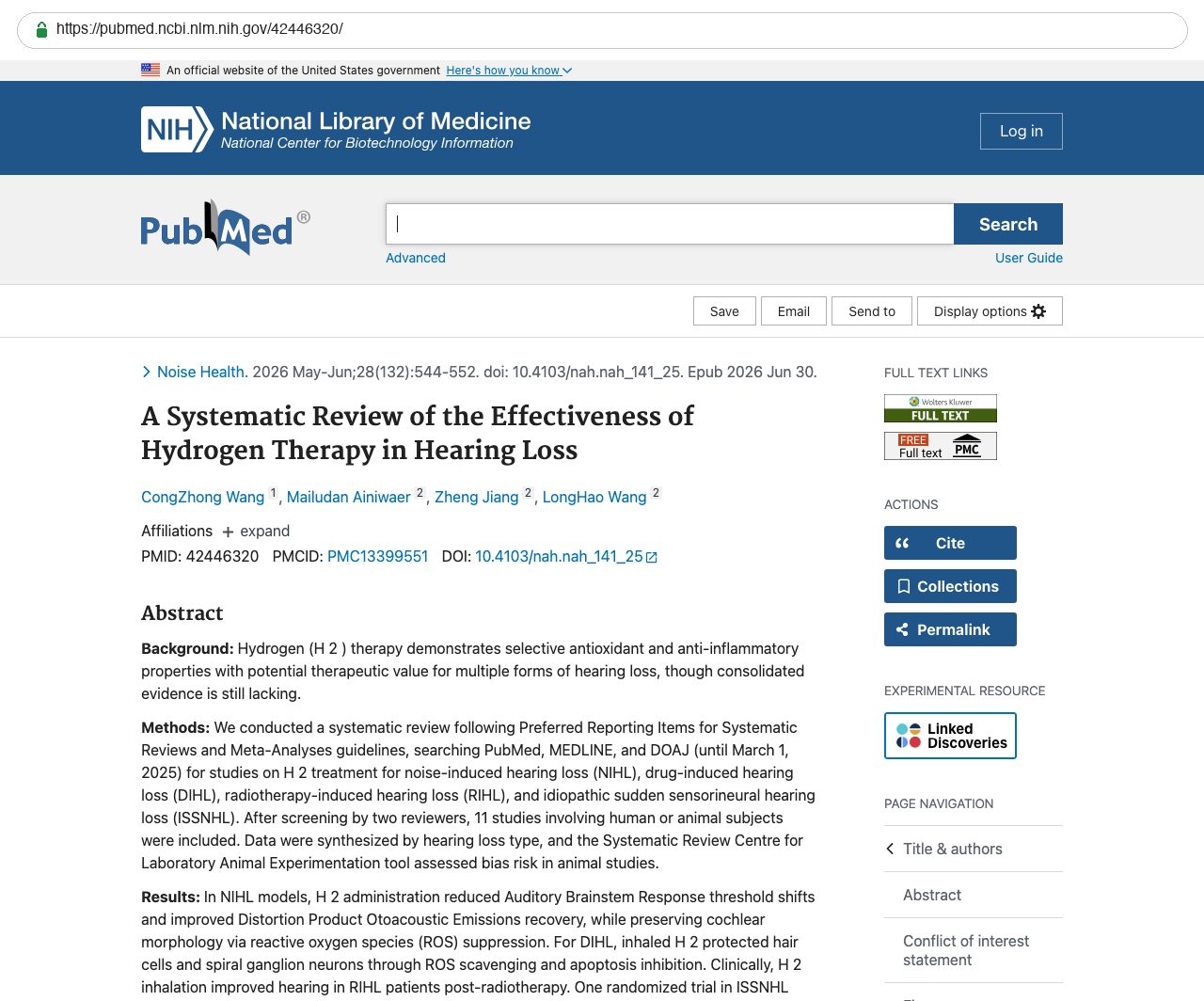
This page mirrors the published abstract (© the authors / publisher) for reference and citation. The canonical source is the PubMed record linked above. This is not medical advice.