2026 · Zhang et al. — A Systematic Review and Meta-Analysis: Does Molecular Hydrogen Exert Radioprotective Effects Without Compromising the Antitumor Efficacy of Radiotherapy or Concurrent Chemoradiotherapy?
Super-Abstract
Pooled data from three clinical studies with 130 cancer patients receiving radiotherapy or chemoradiotherapy showed no statistically significant effect of molecular hydrogen on tumour response compared with control (risk ratio 0.98, 95% CI 0.83 to 1.15). A sensitivity analysis restricted to randomised trials gave a similar result (risk ratio 0.99). The narrative synthesis of all seven included studies (222 patients) reported fewer radiation-induced toxicities, better quality of life and no adverse effect on haematological parameters, but these outcomes were not pooled. (Cureus, 2026.)
Commentary
Radiotherapy and concurrent chemoradiotherapy often cause radiation-induced toxicity, and hydrogen has been proposed to protect normal tissue, which raises the question whether it might protect tumours as well. This systematic review followed PRISMA guidelines and was registered with INPLASY (INPLASY202680108). The authors searched PubMed, Embase and Web of Science from inception to 8 July 2026 for English-language original clinical studies in adult cancer patients (18 years or older) who received molecular hydrogen for radioprotection during radiotherapy or concurrent chemoradiotherapy. Seven studies with 222 patients were synthesised qualitatively. Three of them, with 130 patients, entered a random-effects meta-analysis of tumour response, expressed as a risk ratio. Risk of bias was assessed with validated tools. Radiation toxicity, quality of life and haematological parameters were summarised narratively. The abstract does not state which forms of hydrogen, doses or treatment durations the included studies used, how many were randomised trials, or what the risk-of-bias assessment found.
Key quotes
- „Molecular hydrogen did not significantly affect tumor response compared with the control group (RR = 0.98, 95% CI 0.83-1.15).“ — the pooled main result from three studies with 130 patients
- „The narrative synthesis further indicated that molecular hydrogen reduced radiation-induced toxicities, improved quality of life, and did not adversely affect hematological parameters.“ — secondary findings from the narrative synthesis, not pooled statistically
- „In conclusion, this systematic review and meta-analysis suggest that molecular hydrogen may have radioprotective effects in cancer patients receiving radiotherapy or concurrent chemoradiotherapy, with the currently available evidence showing no significant reduction in tumor response.“ — the authors' conclusion, which they phrase as a possibility
Our assessment
The review asks a safety question that matters in cancer care: whether hydrogen given for radioprotection could weaken radiotherapy. The pooled estimate showed no statistically significant change in tumour response, and the analysis limited to randomised trials agreed. A non-significant result does not establish equivalence. With three studies and 130 patients, the confidence interval from 0.83 to 1.15 is compatible with a modest decrease as well as a modest increase in tumour response. Limitations: few and small included studies, and only three of the seven studies entered the meta-analysis. The abstract does not report the hydrogen forms or doses, the number of randomised trials, the risk-of-bias results, heterogeneity or the certainty of evidence. The reported reductions in toxicity and gains in quality of life come from narrative synthesis only. Only English-language studies were eligible.
Study design
- Type: systematic review and meta-analysis (PRISMA, registered with INPLASY), random-effects model · n: seven studies with 222 patients, of which three studies with 130 patients in the meta-analysis · H₂ delivery: not specified in the abstract
- Included studies: English-language original clinical studies of adult cancer patients (18 years or older) receiving molecular hydrogen for radioprotection during radiotherapy or concurrent chemoradiotherapy. PubMed, Embase and Web of Science searched from inception to 8 July 2026
- Result: tumour response compared with control RR 0.98 (95% CI 0.83–1.15), not significant. Randomised trials only: RR 0.99 (95% CI 0.84–1.17). Narrative synthesis: fewer radiation-induced toxicities, better quality of life, no adverse effect on haematological parameters. Heterogeneity and certainty of evidence not reported in the abstract
Abstract
Radiotherapy and concurrent chemoradiotherapy (CCRT) are widely used for cancer treatment but are frequently associated with radiation-induced toxicities. Molecular hydrogen has been proposed as a potential radioprotective agent because it protects normal tissues from oxidative damage. However, an important concern is whether molecular hydrogen also protects tumor tissues. This systematic review and meta-analysis aimed to evaluate whether molecular hydrogen preserves tumor response while providing radioprotection in cancer patients receiving radiotherapy or CCRT. The Preferred Reporting Items for Systematic Reviews and Meta-Analyses (PRISMA) guidelines were followed for conducting this review. Eligible studies were English-language original clinical studies of adult cancer patients (≥18 years) treated with radiotherapy or CCRT and receiving molecular hydrogen for radioprotection. Three electronic databases (PubMed, Embase, and Web of Science) were searched from inception to 8 July 2026. Seven studies involving 222 patients were qualitatively synthesized, of which 3 involving 130 patients were included in the meta-analysis. The random-effects model was used. The risk of bias was evaluated with validated tools. The risk ratio (RR) was used to estimate the pooled tumor response. Molecular hydrogen did not significantly affect tumor response compared with the control group (RR = 0.98, 95% CI 0.83-1.15). Sensitivity analysis restricted to randomized controlled trials yielded a broadly consistent result (RR = 0.99, 95% CI: 0.84-1.17). The narrative synthesis further indicated that molecular hydrogen reduced radiation-induced toxicities, improved quality of life, and did not adversely affect hematological parameters. In conclusion, this systematic review and meta-analysis suggest that molecular hydrogen may have radioprotective effects in cancer patients receiving radiotherapy or concurrent chemoradiotherapy, with the currently available evidence showing no significant reduction in tumor response. This review was registered with INPLASY (INPLASY202680108).
Source & links
Screenshot of the PubMed page
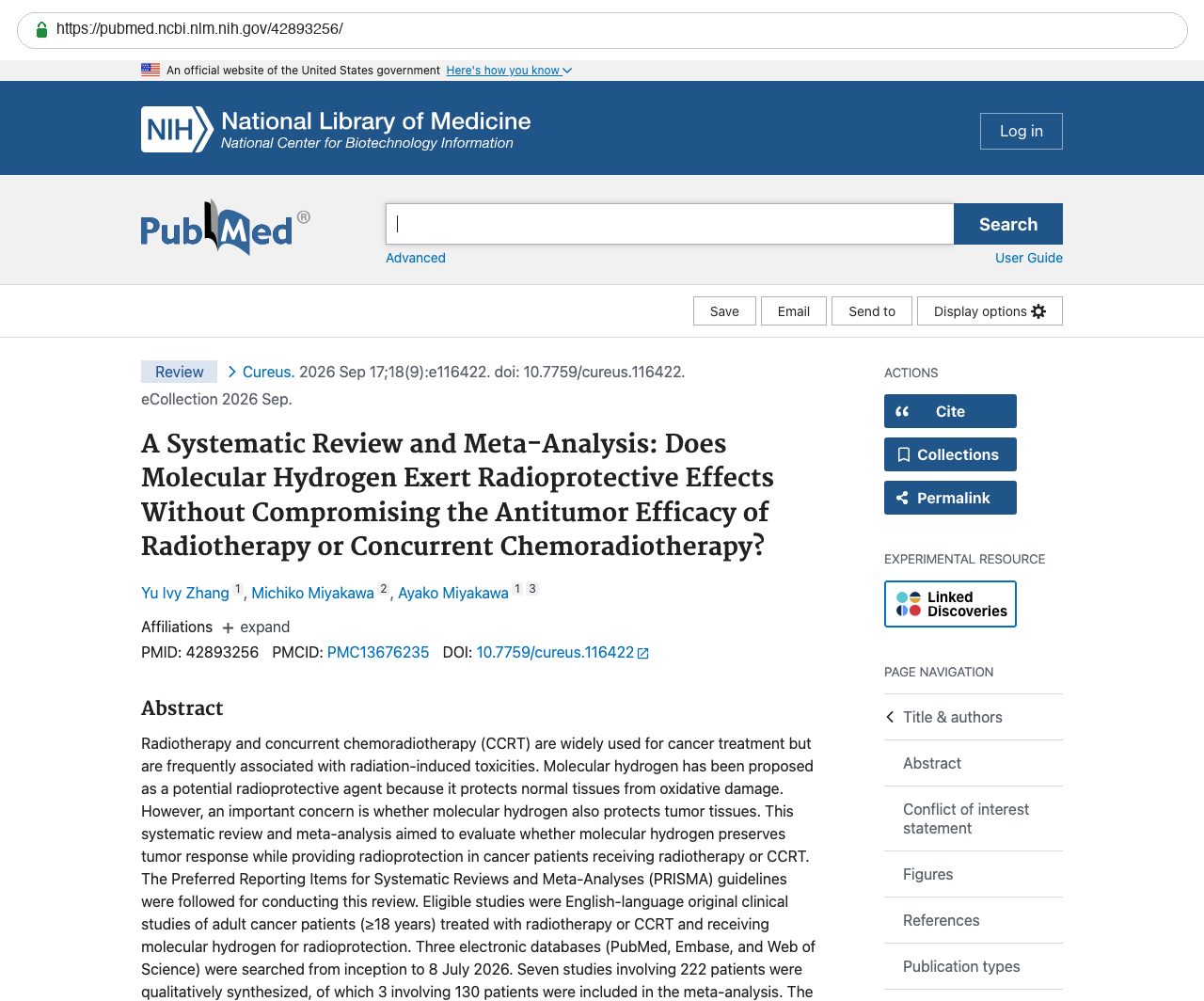
This page mirrors the published abstract (© the authors / publisher) for reference and citation. The canonical source is the PubMed record linked above. This is not medical advice.