2026 · Zhao et al. — Research Progress in Clinical Utilization of H2 as a Pleiotropic Agent
Super-Abstract
This narrative review summarises proposed mechanisms of molecular hydrogen and clinical studies of H₂ in diseases of different organ systems, and it reports no pooled results or new data. The authors write that hydrogen medicine research spans more than 170 disease models and describe clinical research as a growing field. Per full text, the review describes no search strategy or inclusion criteria, so it is a narrative (non-systematic) review, and the authors state that most clinical studies so far are small, single-centre and short. (Frontiers in Pharmacology, 2026.)
Commentary
The authors start from the view that H₂ has selective antioxidant, anti-inflammatory and anti-apoptotic activity, and they ask how far clinical research has come. The paper is a review without new data. Per full text, it names no databases, search terms, search date or inclusion criteria and does not state how many studies it covers, so it is a narrative (non-systematic) review. Per full text, the authors graded the cited studies on a published seven-tier evidence hierarchy, from meta-analyses of randomised trials down to animal and cell studies. The review first covers the physical properties of H₂, delivery forms (inhalation, hydrogen-rich water, hydrogen-rich saline infusion, bathing) and proposed mechanisms. It then summarises studies by organ system, per full text ranging from cancer and metabolic disease to altitude sickness and premenstrual syndrome. There are no pooled effect sizes.
Key quotes
- „To date, hydrogen medicine research has covered almost all types of diseases across organ systems, with more than 170 disease models under investigation.“ — the breadth of the field as the authors describe it, without study counts
- „Through its selective antioxidant, anti-inflammatory, and anti-apoptotic activities, as well as its regulatory effects on cell signaling pathways and gene expression, H2 exerts broad biological effects and has emerged as a favorable pleiotropic therapeutic agent.“ — the authors' framing of H₂, not backed by pooled data in the abstract
- „Here, we extensively reviewed the latest mechanistic understanding of H2 and comprehensively summarized the progress of clinical studies on H2 in diseases of different systems, with the goal of informing future large-scale, multi-center clinical trials and supporting the multidisciplinary development of H2 medicine.“ — the stated aim: an overview meant to inform future large trials
Our assessment
The review gives an overview of where clinical research on H₂ stands, sorted by organ system. It cannot show whether H₂ works for any condition, because it pools no data and, per full text, describes no systematic search, so the selection of studies may be incomplete or selective. Limitations: narrative (non-systematic) review. The abstract gives no number of included studies or participants and no effect sizes. The figure of more than 170 disease models describes how widely H₂ has been studied, not a clinical benefit. Per full text, the authors themselves write that most clinical studies have small samples, single-centre designs, inadequate blinding, inconsistent doses and little long-term follow-up, that most come from East Asian populations, and that many report changes in biomarkers rather than clinical outcomes. For the effect of H₂ on a specific condition, the individual trials are the better source.
Study design
- Type: narrative (non-systematic) review of mechanisms and clinical studies, per full text without a described search strategy · n: not stated (no count of studies or participants) · H₂ delivery: various, per full text inhalation, hydrogen-rich water, hydrogen-rich saline and bathing
- Included studies: number not given; per full text, clinical and preclinical studies grouped by organ system and graded on a seven-tier evidence hierarchy
- Result: no pooled effect sizes. The abstract describes research in more than 170 disease models and growing clinical research. Per full text, the authors conclude that H₂ shows tentative clinical potential and that most clinical studies are small, single-centre and short
Abstract
H2 is a fundamental environmental factor for the origin of life, providing an energetic basis for the emergence of primitive life. Through its selective antioxidant, anti-inflammatory, and anti-apoptotic activities, as well as its regulatory effects on cell signaling pathways and gene expression, H2 exerts broad biological effects and has emerged as a favorable pleiotropic therapeutic agent. To date, hydrogen medicine research has covered almost all types of diseases across organ systems, with more than 170 disease models under investigation. Amid the growing demand for translational applications of hydrogen medicine, clinical research has gradually become a research hotspot. Here, we extensively reviewed the latest mechanistic understanding of H2 and comprehensively summarized the progress of clinical studies on H2 in diseases of different systems, with the goal of informing future large-scale, multi-center clinical trials and supporting the multidisciplinary development of H2 medicine.
Source & links
Screenshot of the PubMed page
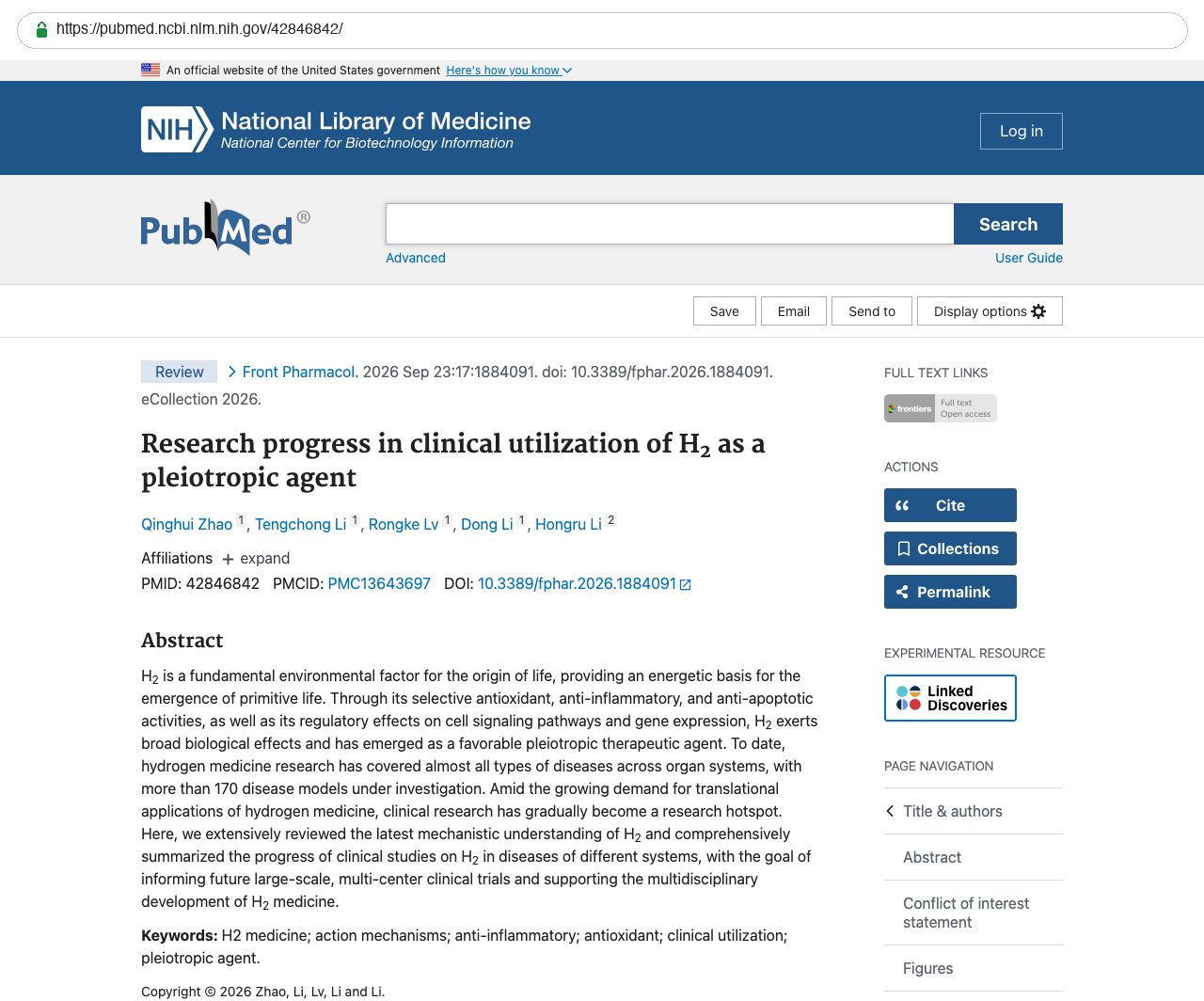
This page mirrors the published abstract (© the authors / publisher) for reference and citation. The canonical source is the PubMed record linked above. This is not medical advice.