2023 · Zhou et al. — Effects of Molecular Hydrogen Supplementation on Fatigue and Aerobic Capacity in Healthy Adults: A Systematic Review and Meta-Analysis
Super-Abstract
Pooling 19 studies with 402 healthy adults, this meta-analysis found that hydrogen lowered perceived exertion and blood lactate by small but statistically significant amounts, with no effect on maximal or peak oxygen uptake or on endurance performance. The pooled effects were SMD −0.38 for perceived exertion and −0.42 for blood lactate, and close to zero for oxygen uptake (0.09) and endurance performance (0.01). The authors describe this as moderate evidence that hydrogen eases fatigue but does not improve aerobic capacity. The individual trials were small, and the abstract does not name the forms or doses of hydrogen used. (Frontiers in Nutrition, 2023.)
Commentary
High-intensity exercise can cause fatigue, possibly through excess reactive oxygen species, and hydrogen has been proposed as a way to reduce it. This systematic review, registered in PROSPERO (CRD42022351559), searched five databases in August 2022 for randomised controlled or crossover trials in healthy adults. Outcomes were the rating of perceived exertion (RPE), maximal and peak oxygen uptake (VO2max, VO2peak) and endurance performance. Blood lactate is also reported in the results. Data were converted into standardised mean differences (SMD) and pooled in random-effects meta-analyses. Subgroup analyses examined intervention period, training status and type of exercise as possible sources of heterogeneity. Seventeen publications reporting 19 studies with 402 participants were included. The abstract does not state which forms of hydrogen were given, at what doses or for how long, and it does not report a risk-of-bias assessment.
Key quotes
- „The pooled effect sizes of H2 on RPE (SMDpooled = -0.38, 95%CI -0.65 to -0.11, p = 0.006, I 2 = 33.6%, p = 0.149) and blood lactate (SMDpooled = -0.42, 95% CI -0.72 to -0.12, p = 0.006, I 2 = 35.6%, p = 0.114) were small yet significant with low heterogeneity.“ — the fatigue-related results: small pooled effects with low heterogeneity
- „The pooled effect sizes of H2 on VO2max and VO2peak (SMDpooled = 0.09, 95% CI -0.10 to 0.29, p = 0.333, I 2 = 0%, p = 0.998) and endurance performance (SMDpooled = 0.01, 95% CI -0.23 to 0.25, p = 0.946, I 2 = 0%, p > 0.999) were not significant and trivial without heterogeneity.“ — the null result for aerobic capacity and endurance performance
- „This meta-analysis provides moderate evidence that H2 supplementation alleviates fatigue but does not enhance aerobic capacity in healthy adults.“ — the authors' conclusion, including their own rating of the evidence
Our assessment
The review is registered and pools randomised controlled and crossover trials. For aerobic capacity and endurance performance, the pooled effects were close to zero and not statistically significant. For perceived exertion and blood lactate, the effects were small and statistically significant. Perceived exertion is a subjective rating and lactate a blood marker, so neither shows a gain in performance. Limitations: 402 participants spread over 19 studies means the individual trials were small. The abstract does not describe hydrogen forms, doses, durations or risk of bias. The fatigue effects varied with training status, intervention period and exercise type, which limits how far the pooled numbers can be generalised. The authors call the evidence moderate, but the abstract does not say how this rating was derived. Only healthy adults were included.
Study design
- Type: systematic review and meta-analysis, registered in PROSPERO (five databases searched in August 2022, random-effects models) · n: 402 healthy adults in 19 studies (seventeen publications) · H₂ delivery: not specified in the abstract
- Included studies: randomised controlled or crossover trials in healthy adults measuring perceived exertion, maximal or peak oxygen uptake and endurance performance
- Result: perceived exertion SMD −0.38 (95% CI −0.65 to −0.11, p = 0.006, I² = 33.6%), blood lactate SMD −0.42 (95% CI −0.72 to −0.12, p = 0.006, I² = 35.6%). VO2max and VO2peak SMD 0.09 (95% CI −0.10 to 0.29, p = 0.333, I² = 0%) and endurance performance SMD 0.01 (95% CI −0.23 to 0.25, p = 0.946, I² = 0%), both not significant
Abstract
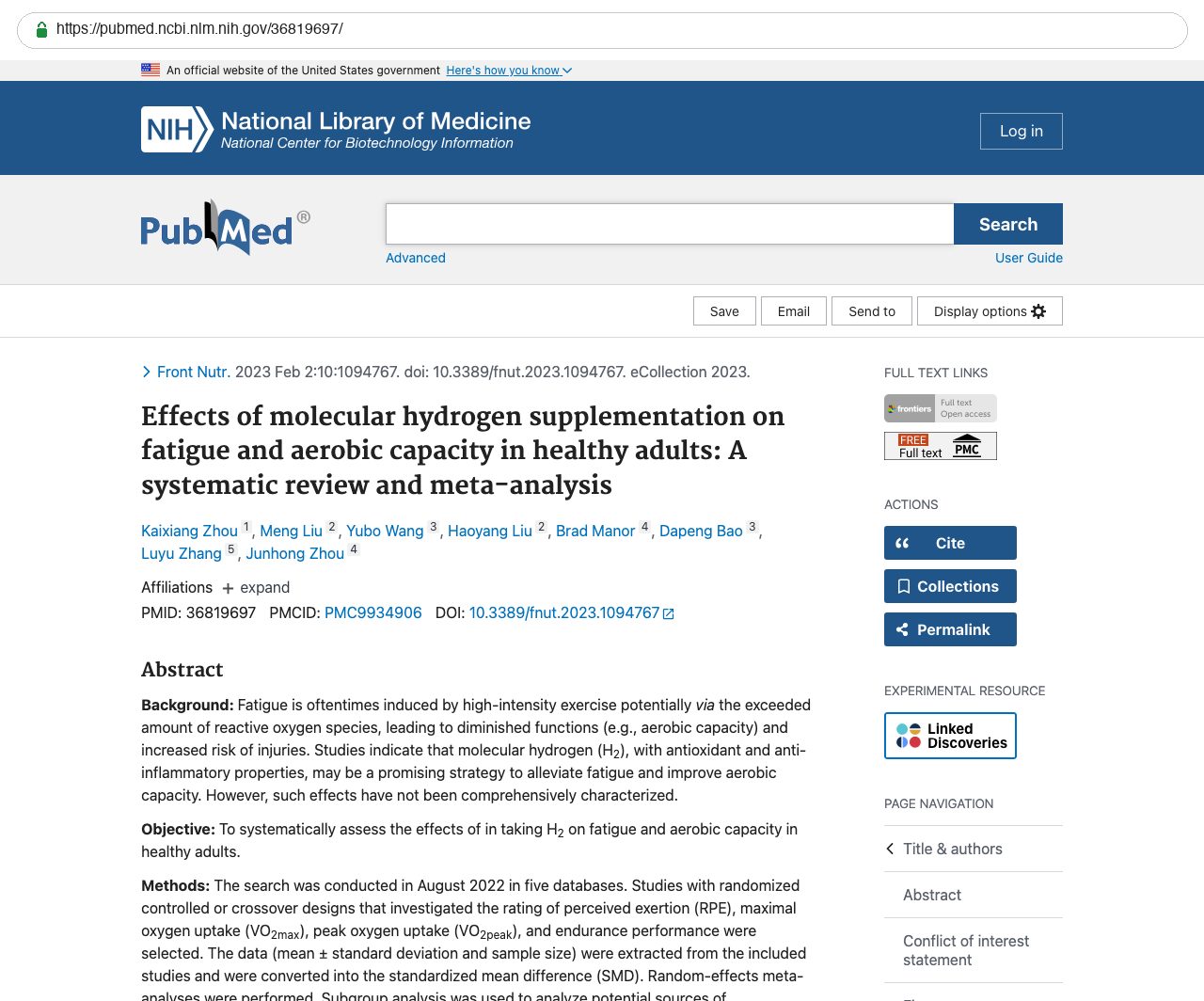
BACKGROUND: Fatigue is oftentimes induced by high-intensity exercise potentially via the exceeded amount of reactive oxygen species, leading to diminished functions (e.g., aerobic capacity) and increased risk of injuries. Studies indicate that molecular hydrogen (H2), with antioxidant and anti-inflammatory properties, may be a promising strategy to alleviate fatigue and improve aerobic capacity. However, such effects have not been comprehensively characterized. OBJECTIVE: To systematically assess the effects of in taking H2 on fatigue and aerobic capacity in healthy adults. METHODS: The search was conducted in August 2022 in five databases. Studies with randomized controlled or crossover designs that investigated the rating of perceived exertion (RPE), maximal oxygen uptake (VO2max), peak oxygen uptake (VO2peak), and endurance performance were selected. The data (mean ± standard deviation and sample size) were extracted from the included studies and were converted into the standardized mean difference (SMD). Random-effects meta-analyses were performed. Subgroup analysis was used to analyze potential sources of heterogeneity due to intervention period, training status, and type of exercise. RESULTS: Seventeen publications (19 studies) consisting of 402 participants were included. The pooled effect sizes of H2 on RPE (SMDpooled = -0.38, 95%CI -0.65 to -0.11, p = 0.006, I 2 = 33.6%, p = 0.149) and blood lactate (SMDpooled = -0.42, 95% CI -0.72 to -0.12, p = 0.006, I 2 = 35.6%, p = 0.114) were small yet significant with low heterogeneity. The pooled effect sizes of H2 on VO2max and VO2peak (SMDpooled = 0.09, 95% CI -0.10 to 0.29, p = 0.333, I 2 = 0%, p = 0.998) and endurance performance (SMDpooled = 0.01, 95% CI -0.23 to 0.25, p = 0.946, I 2 = 0%, p > 0.999) were not significant and trivial without heterogeneity. Subgroup analysis revealed that the effects of H2 on fatigue were impacted significantly by the training status (i.e., untrained and trained), period of H2 implementation, and exercise types (i.e., continuous and intermittent exercises). CONCLUSIONS: This meta-analysis provides moderate evidence that H2 supplementation alleviates fatigue but does not enhance aerobic capacity in healthy adults. SYSTEMATIC REVIEW REGISTRATION: www.crd.york.ac.uk/PROSPERO/, identifier: CRD42022351559.
Source & links
Screenshot of the PubMed page
This page mirrors the published abstract (© the authors / publisher) for reference and citation. The canonical source is the PubMed record linked above. This is not medical advice.