2012 Medical gas research Pilot / Observational Human H₂ therapy Drinking (HRW) Sports & ExerciseOxidative stress
2012 · Aoki et al. — Pilot Study: Effects of Drinking Hydrogen-Rich Water on Muscle Fatigue Caused by Acute Exercise in Elite Athletes
Super-Abstract
In a crossover pilot study with 10 male soccer players, drinking hydrogen-rich water before exercise was followed by lower blood lactate and no significant early drop in knee extension peak torque, while the same players showed a significant drop with placebo water. Blood oxidative stress markers (d-ROMs and BAP) and creatine kinase showed no significant change after exercise. The abstract names no primary endpoint, and per full text the peak torque result comes from comparisons within each drink condition, not from a direct test between the two drinks. (Medical Gas Research, 2012.)
Commentary
Intense exercise causes oxidative stress, and the authors asked whether hydrogen-rich water changes oxidative stress and muscle fatigue after acute exercise. Ten male soccer players aged 20.9 ± 1.3 years were each tested twice in a double-blind crossover design, once after hydrogen-rich water and once after placebo water, one week apart. Neither the abstract nor the full text mentions randomisation of the order. Per full text, each player drank 1,500 ml from three 500 ml bottles between the evening before and the morning of the test, with a hydrogen concentration of 0.92 to 1.02 mM, and the placebo water contained no hydrogen. The test was 30 minutes on a cycle ergometer at 75% of maximal oxygen uptake, followed by 100 maximal isokinetic knee extensions with measurement of peak torque and muscle activity. Blood lactate, oxidative stress markers (d-ROMs and BAP) and creatine kinase were measured repeatedly. The abstract does not name a primary endpoint.
Key quotes
- „Although acute exercise resulted in an increase in blood lactate levels in the subjects given PW, oral intake of HW prevented an elevation of blood lactate during heavy exercise.“ — the main reported result on blood lactate
- „There was no significant change in blood oxidative injury markers (d-ROMs and BAP) or creatine kinease after exercise.“ — the oxidative stress markers, part of the study's aim, did not change significantly
- „Although further studies to elucidate the exact mechanisms and the benefits are needed to be confirmed in larger series of studies, these preliminary results may suggest that HW may be suitable hydration for athletes.“ — the authors' conclusion, framed as preliminary
Our assessment
This small crossover study compared hydrogen-rich water with placebo water in the same 10 athletes under double-blind conditions. Blood lactate after exercise was lower with hydrogen-rich water, and peak torque did not fall significantly in the early phase of the knee test. The oxidative stress markers, which the study set out to examine, did not change significantly. Per full text, lactate rose with both drinks but less with hydrogen-rich water, which is weaker than the abstract's wording that hydrogen-rich water prevented the rise. Per full text, the electromyography frequency measures of muscle fatigue did not differ between the drinks. Limitations: 10 participants, men only and all trained athletes, one test session per drink, no reported randomisation of the drink order, no primary endpoint named, and laboratory surrogate measures instead of performance in competition. The results are preliminary and apply to this small sample.
Study design
- Type: pilot study, double-blind, placebo-controlled crossover, randomisation not reported · n: 10 male soccer players · H₂ delivery: drinking hydrogen-rich water, per full text 1,500 ml with 0.92 to 1.02 mM hydrogen from the evening before to the morning of the exercise test
- Comparator: placebo water without hydrogen (per full text 0 mM), same participants, one week apart
- Result: blood lactate after exercise lower with hydrogen-rich water; peak torque fell significantly with placebo water but not in the early phase with hydrogen-rich water (no figures in the abstract). d-ROMs, BAP and creatine kinase: no significant change. No primary endpoint named
Abstract
BACKGROUND: Muscle contraction during short intervals of intense exercise causes oxidative stress, which can play a role in the development of overtraining symptoms, including increased fatigue, resulting in muscle microinjury or inflammation. Recently it has been said that hydrogen can function as antioxidant, so we investigated the effect of hydrogen-rich water (HW) on oxidative stress and muscle fatigue in response to acute exercise. METHODS: Ten male soccer players aged 20.9 ± 1.3 years old were subjected to exercise tests and blood sampling. Each subject was examined twice in a crossover double-blind manner; they were given either HW or placebo water (PW) for one week intervals. Subjects were requested to use a cycle ergometer at a 75 % maximal oxygen uptake (VO2) for 30 min, followed by measurement of peak torque and muscle activity throughout 100 repetitions of maximal isokinetic knee extension. Oxidative stress markers and creatine kinase in the peripheral blood were sequentially measured. RESULTS: Although acute exercise resulted in an increase in blood lactate levels in the subjects given PW, oral intake of HW prevented an elevation of blood lactate during heavy exercise. Peak torque of PW significantly decreased during maximal isokinetic knee extension, suggesting muscle fatigue, but peak torque of HW didn't decrease at early phase. There was no significant change in blood oxidative injury markers (d-ROMs and BAP) or creatine kinease after exercise. CONCLUSION: Adequate hydration with hydrogen-rich water pre-exercise reduced blood lactate levels and improved exercise-induced decline of muscle function. Although further studies to elucidate the exact mechanisms and the benefits are needed to be confirmed in larger series of studies, these preliminary results may suggest that HW may be suitable hydration for athletes.
Source & links
Screenshot of the PubMed page
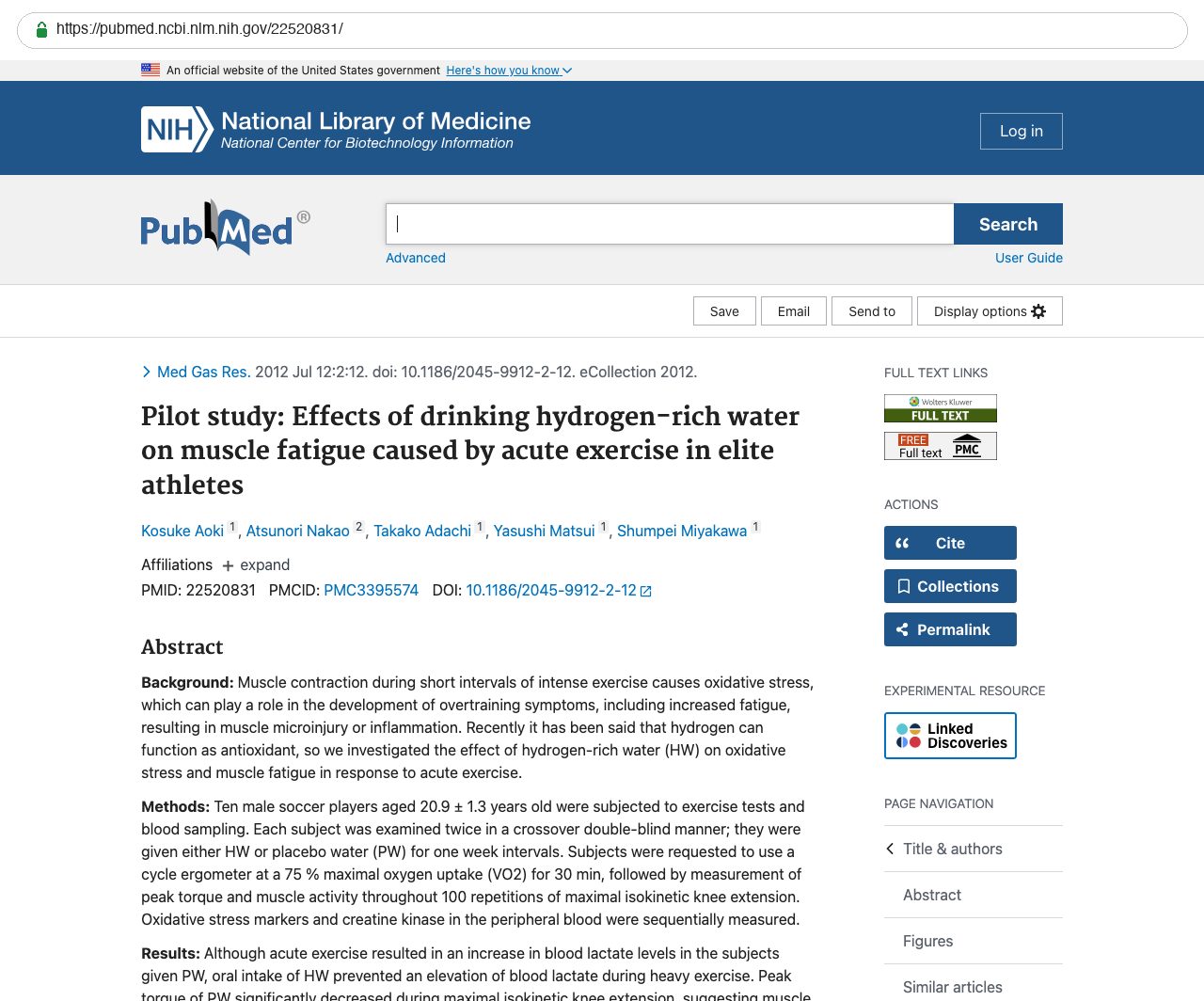
This page mirrors the published abstract (© the authors / publisher) for reference and citation. The canonical source is the PubMed record linked above. This is not medical advice.