2022 Annals of translational medicine Review / Meta-analysis Unspecified Oral healthOxidative stress
2022 · Bai et al. — Effects of Hydrogen Rich Water and Pure Water on Periodontal Inflammatory Factor Level, Oxidative Stress Level and Oral Flora: A Systematic Review and Meta-Analysis
Super-Abstract
This meta-analysis of 17 studies found lower levels of the inflammatory markers IL-1β, TNF-α and IL-6 and of two oxidative stress markers with hydrogen-rich water than with pure water, along with less activity of oral pathogenic bacteria. Glutathione peroxidase levels were higher. The abstract counts 304 subjects, but per full text only 3 of the 17 studies list periodontitis as their research object, while others list gingival cells, oral bacteria, kidney injury or traumatic brain injury, so the 304 cannot be read as human participants. The abstract reports no clinical outcomes such as gum bleeding or pocket depth. (Annals of Translational Medicine, 2022.)
Commentary
Hydrogen-rich water has been used as an auxiliary treatment for periodontitis and peri-implantitis because of its antioxidant properties. This review asked whether it reduces oral inflammation and plaque bacteria. The authors searched seven databases, four international (PubMed, Web of Science, EMBASE, Cochrane) and three Chinese, for randomised controlled trials comparing hydrogen-rich water with pure water in periodontal disease, published before March 2022. Outcomes were inflammatory factors, oxidative stress markers and oral flora. Study quality was rated with the Cochrane risk of bias tool, and standardised mean differences (SMD) with 95% confidence intervals were calculated. Seventeen studies were included, with 304 subjects in total according to the abstract. The abstract does not say whether the water was drunk or used as a rinse, and it gives no hydrogen concentration or treatment duration. Per full text, the research objects of the included studies range from periodontitis and healthy adults to diabetes, kidney injury, traumatic brain injury, gingival cells and oral bacteria, so the 304 subjects cannot be read as human participants.
Key quotes
- „The levels of interleukin (IL)-1β (SMD =-0.73; 95% CI: -1.29 to -0.18; P=0.009), tumor necrosis factor alpha (SMD =-2.51; 95% CI: -3.56 to -1.46; P<0.00001), IL-6 (SMD =-1.31; 95% CI: -1.96 to -0.67; P<0.0001), 8-hydroxyguanosine (SMD =-1.61; 95% CI: -2.35 to -0.87; P<0.0001), and reactive oxygen metabolites (SMD =-0.49; 95% CI: -0.91 to -0.06; P=0.02) in the HRW group decreased significantly, while the glutathione peroxidase level increased (SMD =2.5; 95% CI: 1.85 to 3.15; P<0.00001).“ — the pooled results for inflammatory and oxidative stress markers
- „Among them, 5 studies had a high risk of bias, and the rest had a certain risk of bias, thus, the total risk of bias was medium to low.“ — the authors' rating of study quality
- „HRW effectively inhibits the inflammatory reaction, oxidative stress level, and bacterial proliferation activity in patients with periodontal disease.“ — the authors' conclusion, stated for patients with periodontal disease
Our assessment
All seven pooled outcomes point in the same direction, but they are laboratory markers, not clinical outcomes such as tooth loss, bleeding or pocket depth. The meta-analysis does not show that hydrogen-rich water helps people with periodontal disease. Per full text, only 3 of the 17 studies list periodontitis as the research object. The others include exercise, diabetes, kidney injury, traumatic brain injury, gingival cells and oral bacteria. Limitations: 5 of the 17 studies at high risk of bias, and the 304 subjects in the abstract cannot be read as human participants. Per full text, no included study described allocation concealment or blinding of outcome assessment, and publication bias was not assessed because each outcome pooled fewer than 10 studies. The abstract reports no heterogeneity statistics, hydrogen concentration, route, duration or adverse events. The background claim that long-term drinking may cause abnormal liver function refers, per full text, to rat models and was not examined here.
Study design
- Type: systematic review and meta-analysis of randomised controlled trials (standardised mean differences, Cochrane risk of bias tool) · n: 17 studies, 304 subjects according to the abstract (per full text including cell and bacterial studies, so not a count of human participants) · H₂ delivery: hydrogen-rich water, with route, concentration and duration not stated in the abstract
- Included studies: trials comparing hydrogen-rich water with pure water, published before March 2022, from seven databases, 5 of them at high risk of bias. Per full text, research objects range from periodontitis to conditions outside the mouth, as well as cells and bacteria
- Result: IL-1β SMD -0.73 (95% CI -1.29 to -0.18, P = 0.009), TNF-α SMD -2.51 (95% CI -3.56 to -1.46, P < 0.00001), IL-6 SMD -1.31 (95% CI -1.96 to -0.67, P < 0.0001), 8-hydroxyguanosine SMD -1.61 (95% CI -2.35 to -0.87, P < 0.0001), reactive oxygen metabolites SMD -0.49 (95% CI -0.91 to -0.06, P = 0.02), glutathione peroxidase SMD 2.5 (95% CI 1.85 to 3.15, P < 0.00001), oral pathogenic bacteria SMD -0.91 (95% CI -1.16 to -0.66, P < 0.00001). Heterogeneity not reported in the abstract
Abstract
BACKGROUND: Hydrogen rich water (HRW) was used as an auxiliary treatment for periodontitis and peri-implantitis due to its good antioxidant properties. However, the stability of artificially added active hydrogen was far less than that of pure natural active hydrogen, which greatly reduced active hydrogen molecules number in HRW. Meanwhile, the effect of HRW was relatively slow. Finally, long-term drinking of HRW may cause abnormal liver function. Hence, this study sought to summarize and analyze the effects of HRW on oral inflammation and oral flora in various studies to determine whether HRW can be used to inhibit dental plaque formation and aliviate oral inflammation. METHODS: Randomized controlled trials (RCTs) of HRW and pure water (PW) in the treatment of periodontal diseases published before March 2022 in the PubMed, Web of science, EMBASE, Cochrane, China Knowledge Resource Integrated, Wanfang, and Weipu databases were searched. Changes in the inflammatory factor levels, oxidative stress response, and oral flora were summarized and used as outcome indicators. The quality of included studies was assessed by Cochrane risk of bias assessment tool, and the standardized mean differences (SMD) and the 95% confidence intervals (CIs) were calculated using Review Manager 5.3. RESULTS: In total, 17 studies, comprising 304 subjects, were included in this meta-analysis. Among them, 5 studies had a high risk of bias, and the rest had a certain risk of bias, thus, the total risk of bias was medium to low. The levels of interleukin (IL)-1β (SMD =-0.73; 95% CI: -1.29 to -0.18; P=0.009), tumor necrosis factor alpha (SMD =-2.51; 95% CI: -3.56 to -1.46; P<0.00001), IL-6 (SMD =-1.31; 95% CI: -1.96 to -0.67; P<0.0001), 8-hydroxyguanosine (SMD =-1.61; 95% CI: -2.35 to -0.87; P<0.0001), and reactive oxygen metabolites (SMD =-0.49; 95% CI: -0.91 to -0.06; P=0.02) in the HRW group decreased significantly, while the glutathione peroxidase level increased (SMD =2.5; 95% CI: 1.85 to 3.15; P<0.00001). Additionally, HRW was shown to effectively inhibit oral pathogenic bacteria activity (SMD =-0.91; 95% CI: -1.16 to -0.66; P<0.00001). CONCLUSIONS: HRW effectively inhibits the inflammatory reaction, oxidative stress level, and bacterial proliferation activity in patients with periodontal disease.
Source & links
Screenshot of the PubMed page
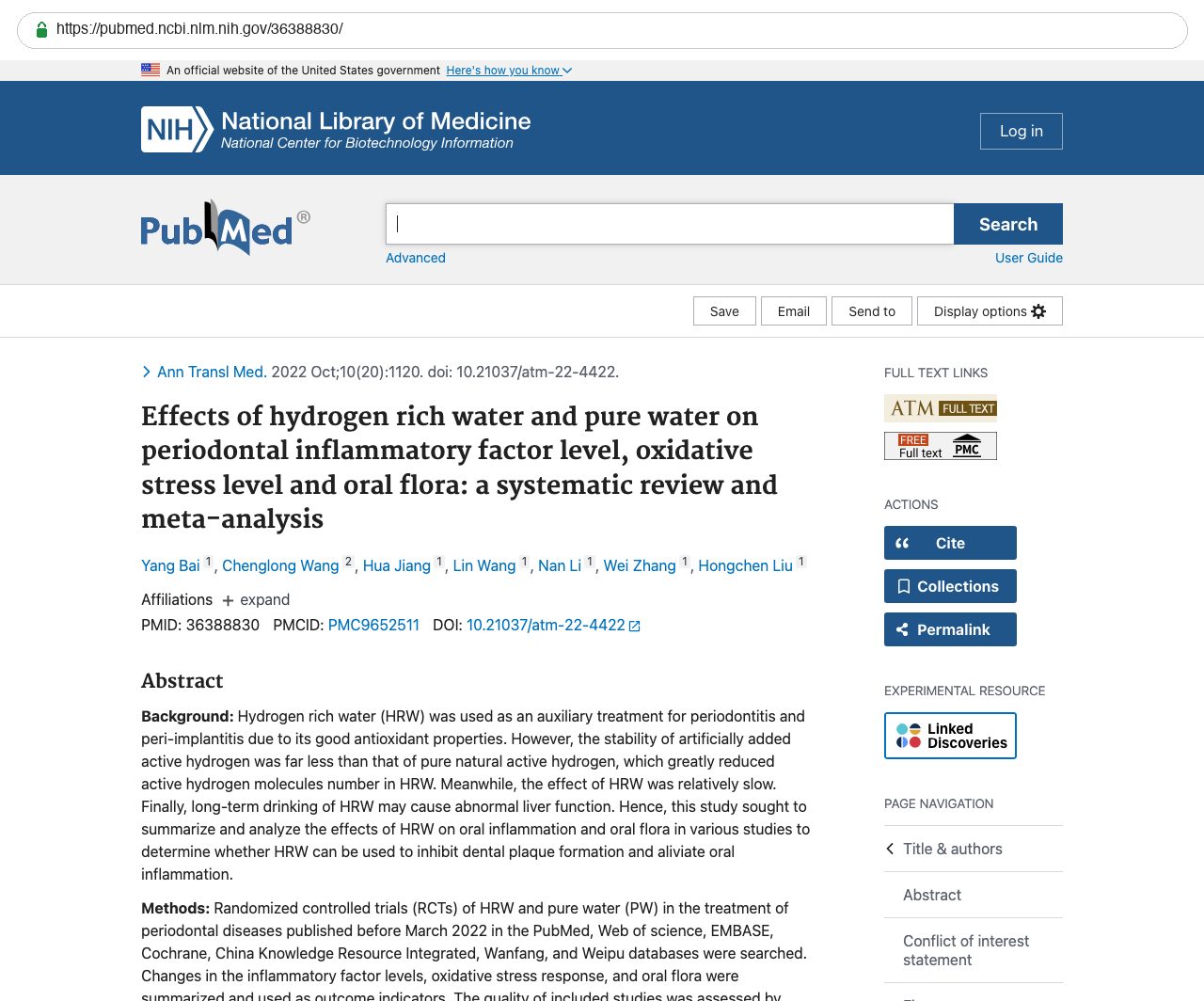
This page mirrors the published abstract (© the authors / publisher) for reference and citation. The canonical source is the PubMed record linked above. This is not medical advice.