2017 · Yang et al. — Protective Effect of Hydrogen-Rich Water on Liver Function of Colorectal Cancer Patients Treated with mFOLFOX6 Chemotherapy
Super-Abstract
In patients with colorectal cancer receiving mFOLFOX6 chemotherapy, liver enzymes and indirect bilirubin rose significantly in the placebo group but did not change significantly in the group drinking hydrogen-rich water. The trial randomized 144 patients, and 76 in the hydrogen group and 60 in the placebo group were included in the final analysis. The abstract compares each group with its own baseline and does not report a direct statistical comparison between the groups, nor the hydrogen dose or how long patients drank the water. (Molecular and Clinical Oncology, 2017.)
Commentary
The authors describe liver damage from mFOLFOX6 chemotherapy, mainly as rising liver enzymes and bilirubin, and asked whether drinking hydrogen-rich water protects liver function in patients with colorectal cancer. This controlled, randomized, single-blind trial recruited 152 patients at the oncology department of one hospital in China between June 2010 and February 2016. Of these, 146 met the inclusion criteria and 144 were randomized to hydrogen-rich water (n = 80) or placebo (n = 64). The final analysis included 76 and 60 patients. The abstract does not give the hydrogen concentration, the daily amount, the duration of drinking or the number of chemotherapy cycles, and it does not say who was blinded or what the placebo consisted of. Liver function after chemotherapy was assessed by alanine aminotransferase (ALT), aspartate transaminase (AST), alkaline phosphatase, indirect bilirubin (IBIL) and direct bilirubin.
Key quotes
- „The hydrogen-rich water group exhibited no significant differences in liver function before and after treatment, whereas the placebo group exhibited significantly elevated levels of ALT, AST and IBIL.“ — the main result, based on before-and-after changes within each group
- „At the end of the study, 76 patients in the hydrogen treatment group and 60 patients in the placebo group were included in the final analysis.“ — dropouts and unequal group sizes after randomization
- „Thus, hydrogen-rich water appeared to alleviate the mFOLFOX6-related liver injury.“ — the authors' conclusion, worded with some caution
Our assessment
The trial is larger than most hydrogen studies and was randomized, but its main analysis compares each group with its own baseline. A non-significant change in one group and a significant change in the other does not by itself show that the groups differed from each other. Limitations: the abstract reports no direct between-group test. The design was single-blind at a single hospital, and the group sizes after randomization (80 and 64) are unequal without explanation. The hydrogen dose and the drinking period are not reported, and no primary endpoint is named. Liver enzymes and bilirubin are laboratory markers, not clinical outcomes. Adverse events and any effect on the anticancer action of the chemotherapy are not reported. Hydrogen-rich water was studied as an add-on to reduce a side effect of chemotherapy, not as a cancer treatment.
Study design
- Type: controlled, randomized, single-blind trial at one hospital in China (2010–2016) · n: 144 randomized (80 hydrogen, 64 placebo), 76 and 60 analysed · H₂ delivery: drinking hydrogen-rich water during mFOLFOX6 chemotherapy (dose and drinking period not reported)
- Comparator: placebo (not further described)
- Result: placebo group: significant rise in ALT, AST and indirect bilirubin after chemotherapy. Hydrogen group: no significant change in liver function before and after treatment. No between-group statistics reported in the abstract
Abstract
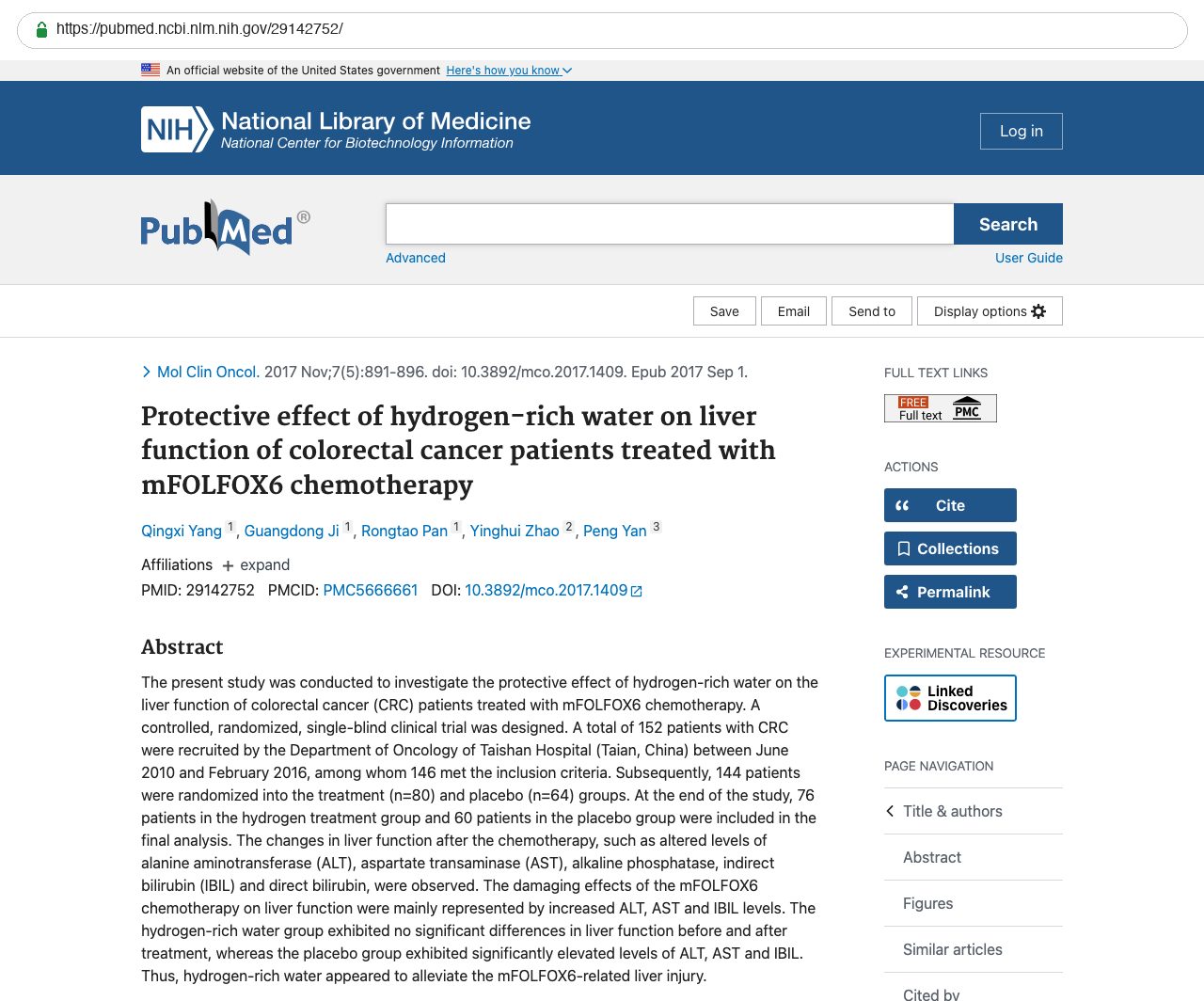
The present study was conducted to investigate the protective effect of hydrogen-rich water on the liver function of colorectal cancer (CRC) patients treated with mFOLFOX6 chemotherapy. A controlled, randomized, single-blind clinical trial was designed. A total of 152 patients with CRC were recruited by the Department of Oncology of Taishan Hospital (Taian, China) between June 2010 and February 2016, among whom 146 met the inclusion criteria. Subsequently, 144 patients were randomized into the treatment (n=80) and placebo (n=64) groups. At the end of the study, 76 patients in the hydrogen treatment group and 60 patients in the placebo group were included in the final analysis. The changes in liver function after the chemotherapy, such as altered levels of alanine aminotransferase (ALT), aspartate transaminase (AST), alkaline phosphatase, indirect bilirubin (IBIL) and direct bilirubin, were observed. The damaging effects of the mFOLFOX6 chemotherapy on liver function were mainly represented by increased ALT, AST and IBIL levels. The hydrogen-rich water group exhibited no significant differences in liver function before and after treatment, whereas the placebo group exhibited significantly elevated levels of ALT, AST and IBIL. Thus, hydrogen-rich water appeared to alleviate the mFOLFOX6-related liver injury.
Source & links
Screenshot of the PubMed page
This page mirrors the published abstract (© the authors / publisher) for reference and citation. The canonical source is the PubMed record linked above. This is not medical advice.